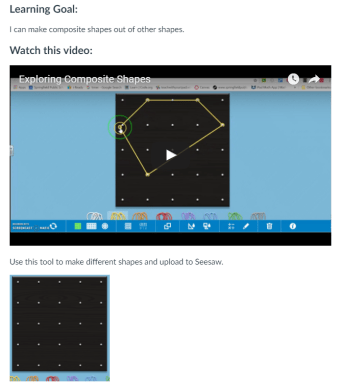
3 Act: Don’t Spill the Beans!

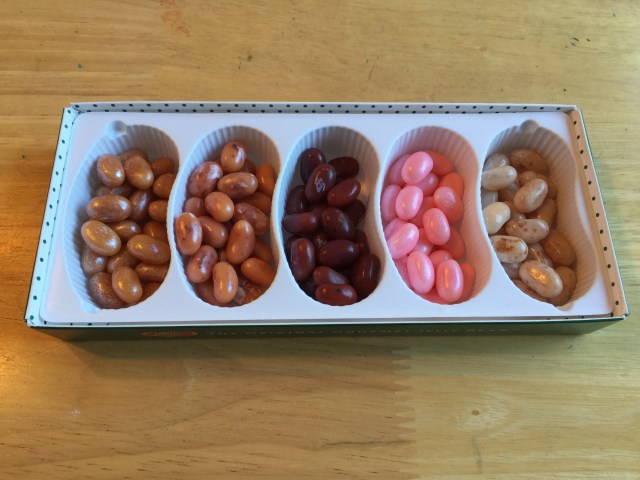
When my son opened his box of Jelly Belly candies I couldn’t resist creating a 3 Act Math task as it was so perfectly set up in five neat compartments.  I am posting the acts here, but there are many different ways you could go with this task.  I have included several options for Act 3 depending on your goal for the lesson.  This task could be used for any of the following CCSS standards, but I have chosen to use it for 2.NBT.B.6 (yes I know it is 5 whole numbers) and 3.NBT.A.3

Act 1:

What do you notice? What do you wonder?

Possible Question: How many beans altogether?

Write a too high and a too low estimate.

Act 2:

What information do you need?

Beans Act 3 RA.png

Act 3:

Beans Act 3 Add Total.png

or

Beans Act 3 Product.png

Other possible extensions:

Which fraction is pink? brown? Write an equivalent fraction.

Here is the blank picture if you would like to change the objective and create your own Act 3:

IMG_3773.JPG


3 Act: Slow Your Roll

Act 1:

What do you notice? What do you wonder?

Possible questions: How many candies are in the package?

How many of each color are in the package?

Act 2:

There are white, pink, yellow, green, brown, black, orange and purple candies.  There are 40 candies altogether.

There are  5 pink candies

There are the same  number of yellow candies as pink

There are 3 less green candies than yellow

There are 4 brown and black candies

There are the same number of brown candies as there are black candies

There are 6 more white candies than pink

There are 4 less orange candies than white

There are the same number of purple candies as there are green, brown and black combined.

Act 3:

Photo:

Act 3 Photo

3 Act Task: Bubble Trouble

I have a stock pile of 3 Act tasks I have been waiting to film over the past few months and am just now carving out a few hours to get them going.

When I saw this bag of bubble gum at the store, it stood out because there were 3 flavors. My mind immediately went to structuring an addition problem with 3 addends for first grade.  Here is what I came up with.  I decided to add the ten frames for the reveal as I wanted students to pay attention to how the 8 and 2 could be combined to make a 10.  I feel like adding that opened this task up to another standard.  Please comment on how to extend the task or modify it to make it better.  It takes a math village:)

CCSS 1.OA.D.8 and 1.OA.C.6.

Act 1:

What did you notice?  What do you wonder?

Question: How many pieces of bubble gum are in the bag?

What is an answer that is too high, too low?

Act 2:

What information do you need to answer the question?

There are 10 apple, 8 grape, 2 watermelon

Act 3:

Why Flip Math Class?

Flipped classrooms have been the topic of conversation for the last few years.  I remember being in Italy in a small town on the Amalfi Coast and seeing a plaque for a flipped classroom.  I’m not sure why it struck me to see this type of classroom on another continent, but it did.  I had just heard about the practice and was excited that the technology in classrooms was catching up to the idea of personalized learning so that it could become a reality in the schools in which I was coaching.  Since then, I have helped many teachers start the journey of flipping their classrooms and have modeled what it can look like in multiple grade levels.  Last year, I was able to implement flipped lessons in the first grade classroom with my students in mathematics.  That experience has taught me a lot about what I find important in flipped lesson design and independent practice and allowed me to refine those components.

There is a lot of anxiety when first introducing this concept to elementary school teachers.  It’s similar to talking to high school teachers about math stations.  There is a misconception that math stations are only for elementary kids and that flipped lessons can only be implemented in high school. Although this is a common misconception, I would like to note that there are many components that must be in place in order for either to be successful.  A really great flipped lesson will incorporate opportunities for students to interact with mathematics with concrete materials or with models.  It is equally imperative that the math block consist of opportunities for students to engage in discourse and discussion.  Collaboration is key in all content areas, but in my opinion, especially in mathematics.  One of the key components to an effective flipped is bridging the link between conceptual -> pictoral -> abstract.  When introducing a concept using materials, a written model should also be provided as well as a bare number task.  This has been the missing component in building student proficiency in younger grades.

Students need to be able to connect the tasks they are completing to numerical representations.  A great way to make sure this happens is create inquiry tasks that allow students to make sense of the mathematics begin taught instead of simply following procedures.  For instance, I could pose the scenario: The answer is 12, what is the question?  Or consider the number model 3 + 4 = 7, make a Stop Motion video to tell the story of the equation.  Math isn’t about pages of problems, it is about meaningful connections and opportunities for discourse.  Once students start to see math as creative, it will change the way they approach the subject.

It can be really intimidating to record yourself on camera.   I have flipped many lessons, and it is definitely a different feeling to know that your instruction is being recorded and archived.  You are more aware of your every word, more intentional about your language, and more precise with instructional strategies.  In my opinion, that is a great thing!

Why Flip Your Classroom?

Take Two

We’ve all been there; we’ve planned the perfect lesson and know exactly how we are going to present the math, but we start the delivery and it all goes South.  When you record a lesson for students, you have the opportunity to capture your best teaching.  It’s like the difference between live television and pre-recorded TV shows.  You have the opportunity to edit and make them more refined because you are choosing and editing the best take.

Continuity

Many schools require all students in each grade-level to teach content areas at the same time with the same objective.  We could debate all day about this practice, but the key concept to take away is that we want to make sure we provide all students with a rigorous curriculum while still allowing for personalized instruction within their ZOPD.  Flipped lessons are a great way to allow students to have access to the same grade-level content, but also get the interventions they need either forward or backward.  This is done by allowing students who have the concept to complete their work and move on to newer concepts.  Students struggling with the concept can receive additional guided practice with the teachers because she/he has time to meet with them individually or in small groups.  A common misconception is that “struggling learner” means that a student has a low IQ or doesn’t have a particular subject ability.  The truth is that we all have different strengths and experiences and a student who struggles with number sense may very likely soar through geometry.  So instead of keeping that student in number sense during independent work time, let them pick their area of strength and complete it and then allow more time for assistance with areas of struggle.

Rewind -> Replay

Struggling students aren’t the only ones who need access to past lessons.  Many students who have “mastered” concepts need review at times.  As adults, we sometimes fail to realize that things we take for granted such as looking up a conversion chart on our telephones when buying something sold in mL is a learned behavior on how to navigate mathematics.  The same goes for when we need to install a new dryer and we have to look up a YouTube video on how to convert the outlet.  Students need to know how to find information when they need it and one way to do that is to provide them with past lessons to review conceptual and procedural knowledge when they need it.  I’m not embarrassed to say that I’ve had to look up how to do long division as an adult math teacher because I have accepted the fact that my brain doesn’t have to hold that information because I rarely use it.  It is rare that I am faced with a division situation that needs to be so precise that I need to use long division, and if I do, I pull out my calculator.

Game Directionsgame.png

I like to record my game directions for stations because it allows students to go back and revisit expectations if they haven’t played for a while or are having a disagreement about the rules.  This solves a lot of behavioral problems without my intervention.


Lesson Organization

adding 10

flipped shapesThere are many ways to organize your lessons, but I have included a picture of the way I laid out our lessons for math each day.  For young learners (and old) it is important to provide them a snapshot of the materials needed for the lesson so that once they begin the video, they have all the necessary materials to complete it.

Accountability

We used many ways for students to share their work, but the most effective way for us was the use of SeeSaw Learning Journal.  Students could upload a screenshot of their work from an app or a picture of their independent practice page or completed activity.  This was a really easy way for me to confirm if the student had completed their practice yet.  As mentioned in a previous post, I have designed a personalized learning path for students to track their own standard mastery but we did not get to implement it last year.  I’ll be sharing more of that work in future posts.

Additional Considerations

Revisit your flipped lessons regularly.  Don’t keep the same lesson if you have found better ways to teach it.  Refine your work and stay on the cutting edge of research.

Constructing Shapes

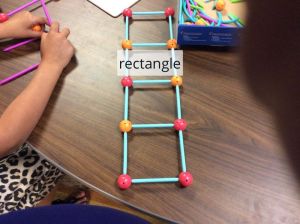
Personally, I think Ava Rectanglethat geometry is one of the more concrete concepts for students to grasp in primary grades; quite literally.  There are tons of ideas of how to construct shapes on the internet, in math books, etc.  I love the activities with spaghetti and with Popsicle sticks and gumdrops, but those activities can be limiting when working with shapes with curved sides.  These activities can be misleading when students decide to extend shapes and we have to be very careful that we not provide fixed and limiting language such as, “the gumdrops are the vertices” because that is not true in a shape like the one to the left.

We recently bought a set from Learning Resources that, in my opinion, is the best out there for allowing students to construct two and three dimensional shapes and combine shapes to make new ones.  I used these in my small groups to let students explore and then name their shapes.  We use Seesaw in our classroom as a learning portfolio and after students made their shapes, they took a picture and labeled them on their Seesaw accounts.

The standard I had in mind with this exploration was: 1.GA.2: Compose two-dimensional shape or three-dimensional shapes to create a composite shape, and compose new shapes from the composite shape.

It’s so interesting to watch and listen as students construct their shapes.  Just as with any creative activity, students who are identified as struggling learners by standardized tasks excel at the task and take the initiative and go further with their learning because they aren’t inhibited by language or symbols that they aren’t yet able to make sense of.  Often the accelerated learners on standardized tasks do the bare minimum to complete the task and move on.  I think these observable behaviors tell us a lot about the mindset of the student and their past experiences with learning.  They also tell us which students value play and which value praise.

Misconceptions:

David 2David Open SquareOpen-ended tasks like these are my favorite because they allow opportunities for students to explore misconceptions like the one here.  This student doesn’t yet understand that a shape must be closed.  This was an opportunity for me to quickly see that and perhaps more importantly for other students to notice and provide feedback.  The picture on the right is the square after he corrected it (and his understanding of shapes).Jamie Oval

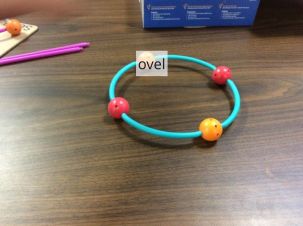
This student had a misconception about circles and ovals which I may not have found so easily without this time to explore and create.

Differentiation:

These tasks are low entry, high ceiling opportunities because all students can make a shape and most students end up stretching their knowledge andAva Triangle vocabulary because they end up making shapes that they cannot name.  This leads to all kinds of discussions on how to categorize shapes and the difference between two dimensional and three dimensional shapes.  I provide students the written names of shapes once they name them and ask how to spell it or if they cannot name it and I am helping them name it for the first time.  Here are some examples of two-dimensional shapes students created:

Three-dimensional shapes:

Combining Shapes

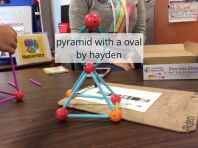
YoumnaThis student started out with a square and built onto it to make it a rectangle.  She discovered how to Pyramid w Oval Haydencombine shapes to make new ones.

This student combed a 3D and a 2D shape to make a sculpture.

LamarThis student is one of my very low performing student sin most subjects, but in math he excels because he is able to make sense of his own learning through play and discovery. Sean Rect Prism

I used this picture earlier, but this student started with a cube and decided he wanted to extend it to see what it turned out to be.  He needed help naming it, but loved that he had discovered a “new” shape.


Conclusion

We shouldn’t limit ourselves to tasks that offer fixed outcomes.  We must search for tasks that allow students to be creative and “build” their own meaning.  As you know, I am a huge proponent of STEAM integration in primary grades and this is just one example of a task that melds mathematics and 21st century skills.  We need to let kids explore more and allow ourselves as educators to do less talking and more listening!

3 Act: How Much Joy?

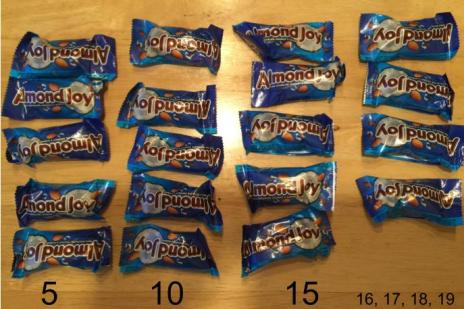
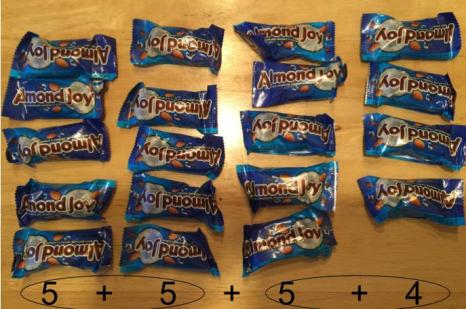
This task supports a couple of different standards in first grade, but I feel it best fits 1.OA.B.3 if used with the Act 2 problem “there are three groups of five and four more.”  It would fit standard 1.NBT.B.2 if using the Act 2 prompt “there is one group of ten and nine more.”

It would be a great place to start before introducing counting on with coins in second grade for standard 2.MD.C.8.

Act 1:

What do you notice?  What do you wonder?

How many candy bars are in the bag?

Act 2:

1.OA.B.3: There are three groups of five and four more

1.NBT.B.2: There is one group of ten and nine more

Act 3:

Act 3 Joy

Act 3.1 Joy

Act 3.2 Joy

3 Act: A Delicious Mix

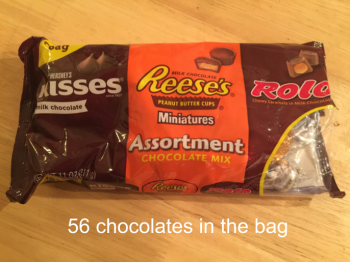
I always draw inspiration from the candy isle, doesn’t everyone?  Tonight I was planning to buy some candy for another 3 Act task I was planning when I spotted a bag of 3 different chocolates…on CLEARANCE!  Immediately I thought of fractions and so the 3 Act task below was born!  Please comment and tell me how I can  improve it or add extensions as I am wiped for the day and just wanted to end it with some math:)

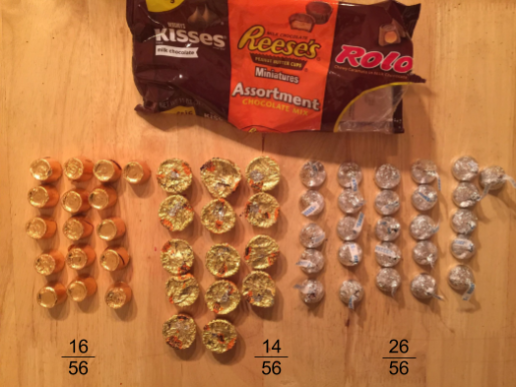
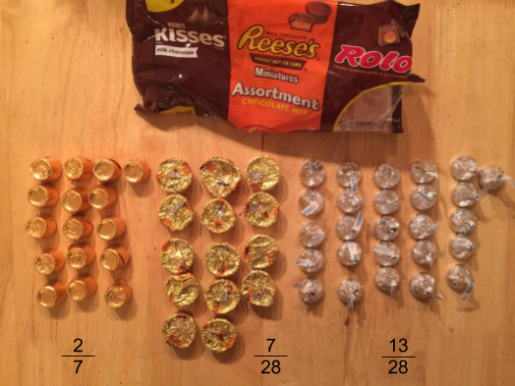
This task will address standard 4.NF.B.3.A if using the 1st Act 3 slide with fractions with the same denominator.  You may choose to address standard 4.NF.A.1 by extending to the 2nd Act 3 slide and having students write the fractions in simplest form.

Act 1:

What do you notice?  What do you wonder?

What fraction of each kind of candy are in the bag?  Make a too high and a too low estimate.

Act 2:

What information will you need to find a solution?  What do you know?  What do you need to know?

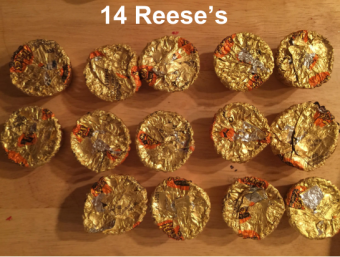
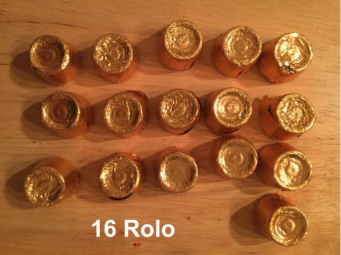
A Delicious Mix Reeses Act 2A Delicious Mix Rolo Act 2Act 2 Total

Act 3:

Where you correct?

A Delicious Mix Act 3A Delicious Mix Act 3 Reduced

As always, let me know how I can make this better and if you see a more appropriate standard alignment!  I look forward to the feedback!

Thanks for the feedback!  Here are some suggestions from MissMathTeacher314: This addresses standard 3.NF.A.1 as well for fraction identification and defining equal parts.
Extensions could include: How many more kisses than rolos? How would you equally share these with 4 friends? How many bags would you need to buy so everyone in your class would get 3 peanut butter cups?
You could give the simplified fractions of the Reese’s and the Rolos for Act 2 rather than the exact count. Flip the script to ask how many pieces of each candy are in the bag rather than asking for the fraction.

Stop Motion Number Stories

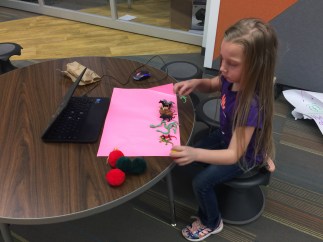
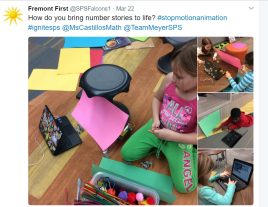
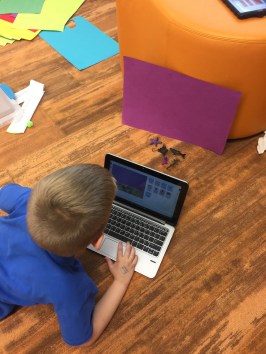
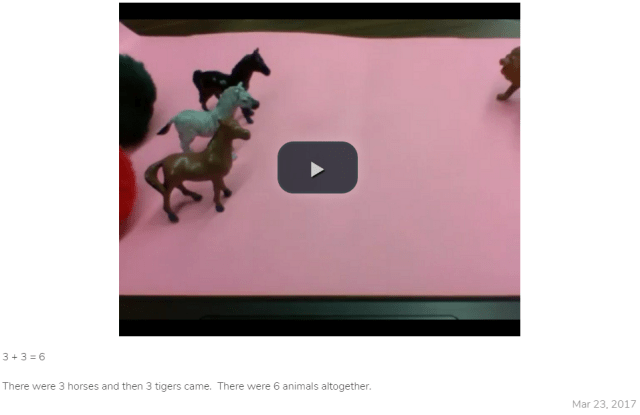
The last couple of days we have been making stop motion videos to represent addition IMG_0453.JPGstories.  The learning goal was to use objects to represent an addition story and then tell the story and write the addition sentence that was represented.  My main goal was really to get students familiar with stop motion in this context and to get the process of shooting the videos and writing the caption in #Seesaw to become easy.

As all things go when teaching 6-year-olds new tools, the process was long and it took me two days of small groups to work with each of our 37 students, but the result was worth every minute!

twitter1.pngMany of our struggling and reluctant learners lit up when they got to pick out animals for their videos!  I didn’t have to convince them to complete the assignment…they wanted to!  Which as you know by now, are the type of assignments I love to give!

Since my goal over the past two days was more process specific to the tools being learned, I scripted most of the stories for students on Seesaw to speed up the process, but made sure they knew how to add a comment for next time when it is up to them to do the writing!

It was great to hear a couple of students say, “I’m going to create a subtraction story now!”

IMG_0452.JPGMy goal is to have Stop Motion Math be a station choice in our room and provide open ended prompts or learning targets to prompt their creations.  Things I would like to do in the future include providing number sentences that need to be represented with a story, providing word problems to solve with a video, and expand into all other standards as a means to show mastery of a concept.

I had so much fun doing this today and saw so much excitement, that I decided to start a website called http://www.stopmotionmath.com that will be up shortly to showcase examples of student work and problems and prompts and ideas of how to use this in your classroom.

We use the Stop Motion Animator extension from the Google Chrome Store.  My partner teacher used this earlier in the year for some literacy tasks, so I will ask her to share those as well.

So excited to do more of this with our kiddos!

Here are some video examples:

Can you guess their story?

Brooklyn’s Video:

Brooklyn’s Post:

Brooklyn1.png

Francis’ Video:

Francis’ Post:

Francis1.png

Aiden’s Video:

Aiden’s Post:

Aiden1.png

Sean’s Video:

Sean’s Post:

Sean1.png

Lamar’s Video:

Lamar’s Post:

Lamar1.png

Alyvia’s Video:

Alyvia’s Post: Alyvia1.png

How Do I Change Math Class Tomorrow?

As Dan Meyer put it, “math class needs a makeover.”  It breaks my heart to hear students say things like, “I’m not good at math” or “I hate math!”

In my opinion, one of the first things that needs to change is the focus on correct answers and the need for speed.  This leads students to believe that the only way to be good at math is to be right (quickly).  The other practice that needs to be eliminated is the language we use as teachers such as “that’s right” or “you’re so smart.”  

You’re So Smart

You’re so smart is one of the most damaging things you can say to a child.  What is smart?  What do we value and what are we showing them that we value?  Being smart needs to mean learning as a means in itself.  Or rather, the journey of learning.  This is not fixed but ever-evolving as we seek out and synthesize new information.  

As a parent, I have been guilty of this.  I’ll blame it on ignorance, but the truth is I kept it up for years as a teacher and a mother.  I knew the words tasted sour in my mouth, but they continued to come out and I continued to damage my child’s self-worth.  Harsh?  It’s true.  

Here is an example:

My oldest son started the district gifted program as a first grader.  I was so proud!  From the time he was born, I had told him how smart he was.  He had finally been classified by the school system in the same way.  My job was done.  From that day on, his life would be rainbows and butterflies.

The reality was that from that day on, he began to feel even more isolated.  He went on to the full-time gifted program in sixth grade and I ended up pulling him out.  His stress level was through the roof, he was failing ALL of his classes, our family time was dominated by reprimands of his failure to finish his homework (which was unending), and the school’s solution to the problem was to medicate him.  We had failed him.  We taught him that learning was about homework and work completion and not about creativity and problem solving.  The other message we sent was one of conformity; You must fit in this box to be “smart” or successful.

He told me a few years later that he felt like the test had been wrong, that they made a mistake; He wasn’t gifted.  He went on to say that he felt pressure to always have the answers (and have them fast) and when he didn’t his failure was paramount.  Teachers expected more of him ALL THE TIME and living up to that expectation was stifling.  I had taught him and the label had taught him that intelligence was fixed.  We told him he was special, but not in a growth sort of way.  He had already arrived at being “smart” and now he would have to maintain the title.  

Luckily, my second child was eight years after my first and my message as a parent is now vastly different.  I praise reflection and strategy and determination.  I allowed him to be tested for the gifted program (telling myself that I could better understand his needs if I did, a lie to be sure).  I realized that I had some lingering pridefulness attached to the label that I am still working out.

However, this time, when I presented it to him, I framed it very differently than I did with my first.  I told him that there was a school with additional opportunities for learning that he might enjoy.  I let him choose whether or not he wished to attend.  He attended in second grade and decided to not attend this year.  

My message to parents is now this: if you want to compliment your child academically, focus on effort and inquiry.  Say things like:

“Wow, I can tell you really worked hard on that.”

“I love hearing about all the new things you are learning, I can tell how much you enjoy it.”

“What are you excited about learning next?”

You’re Right

More talk I’ve tried to eliminate along the way is saying “you’re right.”  This simple phrase takes all of the learning away from the student and places the parent or teacher in the seat of a referee.  Student work becomes not a creative endeavor, but a race to impress the parent or teacher.  The focus is taken off of learning and put on performance (which is what is done when training circus animals).  

If we really want students to become problem solvers, we need to ask the right questions and probe for understanding.  Students need to own their solutions and the first way to do that is to change our language as teachers.  Curriculum Associates has a great list of prompts teachers and parents can use to shift the focus to meta-cognition and justification.  Many of the prompts illustrate how to help students own their own learning and be confident in their solutions, thus allowing them to engage in the standards for mathematical practice.

I have a couple of examples I would like to share about this topic.  One comes from my own child who recently graduated high school (the one referenced above).  

I can pinpoint the day he first viewed himself as a failure in math.  It was third grade and his teacher was a wonderful lady who was energetic and nurturing.  She had been teaching for almost thirty years and all the students loved her.  She (like many still do) had students master multiplication facts using a battery of timed tests.  I’m still not convinced she believed this was the best way to learn facts but like many others had been given the message that students needed to “know” their facts quickly and this was the way it was done.  She had a cute little board that she used to keep track of their progress where they would build their ice cream sundae as they completed their facts.  

I always knew when it was a testing day, because my son would come home with a look of failure on his face.  Math was no longer about creativity for him, it was about being fast and being right.  He did not perform well under time constraints and though his idea of fun in the car was to practice multiplication problems and discuss his creative strategy for solving them, it had lost its luster once he was asked to do it quickly.  He took Algebra 3 times and finally passed due to a teacher who really understood his learning style and a course that was self-paced.  He hates math and instead of wanting to pursue a career in astronomy or chemistry like he previously had dreamed of, he decided that he was too bad at math to go into those fields.  My heart broke when he first told me he just didn’t think he could cut it through the math courses; It broke.  

Another example can be provided by a middle school student whom I tutored for about a year and a half.  She was failing sixth grade math and had severe anxiety about it.  The first time we met, I gave her an assessment on number sense.  She quickly (very quickly) would give me an answer in a very fast, short response, then look at me in terror and say, “is that right?”  I knew immediately that this girl did not struggle with math, she struggled with confidence due to the experiences she had been provided.  We quickly came to an understanding, one my students know well.  “I don’t care how fast you come to a solution as long as you can walk me through your strategy and prove it.”  I have had the exact same experience with every student I tutored over the years.  They are terrified of being wrong, and they have no way of proving they are right because that has never been the focus of instruction.  I wonder if the focus had been on understanding if they would have ever “needed” a tutor.

Lessons Learned

What I have learned, thanks to many phenomenal authors and researchers and my experience teaching diverse learners, is that all students have individual strengths and passions and they all deserve diverse learning experiences in math and outside of math.

Perhaps we need to quit asking all students to “master every standard” in every subject and agree on a set of skills required to be contributing members of society and then let students find their passion and develop it.  We need to remove the labels and focus on the individual.  Students need to be exposed to new ideas and problems so that they can find their passions, but asking them to master every concept is no longer something that our world requires of them and perhaps never did.

I will end with this, it is my belief that the most powerful thing we can do for a child is teach them how to learn.

A Few of the Resources That Have Helped Shape My Beliefs:

Mathematical Mindsets

Mindset

Number Talks

Teaching Number in the Classroom

USMRC

Dan Meyer

Robert Kaplinksky

Jo Boaler

Graham Fletcher

Twitter – #Elemmathchat
 

3 Act Task: The Package Problem

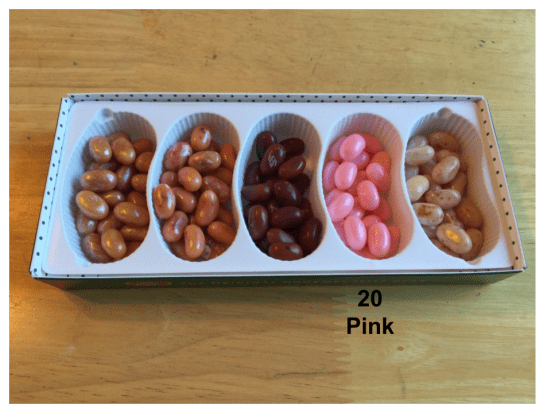
We have had a question we have used for years in Title One Math that continually stumps students in division situations because of the context of the problem.  It is an excellent way to get students to think about the remainder in a division problem as it applies to different situations.  We lovingly refer to this as the package problem.  The question is, I have 34 cupcakes. They are packaged in packages of 6.  How many packages will I need?

When I was making and packaging my annual Christmas pretzels this year, I took a few pictures and thought this might be an excellent example of the package problem.

There are many different scenarios for this task which is what I think makes a really rich task.  You can ask, “How many packages of three will I be able to give out as presents?” or “The pretzels are packaged in packages of 3.  How many packages will I need to package all of the pretzels?”  The first question ignores the remainder because it is irrelevant to the situation.  The second question requires students to look at the remainder as a necessary part of the problem, but allows them to recognize that the last package will not be complete.  If I pair the first question with a third question, “How many will not be packaged?” attention is called to the remainder and can lead to a discussion such as, “Why did I make 2 extra?” or “How would I package them if I wanted to give a bag to each of 6 friends?” or “If I didn’t want to have any pretzels remaining, how could I package them?

Problem solving is all about context.  In my opinion, the reason students don’t do well with word problems is because they are not exposed to multiple contexts in mathematics when skills are taught in isolation.  Hence, the power of 3 Act Math Tasks (thanks Mr. Meyer).  I hope you enjoy this task and would love your feedback as always!

When I was taking pictures for this task, I was elbows deep in melted chocolate so I forgot to take some of the pictures I needed for the different contexts.  My plan is to make another batch soon and add those:)  So for now, I have the third act addressing the first question.

I’ve added a link on the 3 Act main page of my site to the google folder with all of my tasks, videos and pictures.  That way you can choose the pics you’d like. I love to use Nearpod for my 3 Act Tasks when I teach for the awesome opportunities for student input and data analysis:)  However, every time I run a Nearpod session it breaks the link to my blog, so I thought Google might be a better way to share these:)

Act 1: 

IMG_9263.JPG

What do you notice?  What do you wonder?

How many packages will I need to package all of the pretzels?  Write a too high and a too low estimate.

Act 2:

act-2-pretzel-1Act 2 Pretzel 2.png

There are 26 pretzels.  Pretzels are packaged in bags of three. (Insert preferred question here) Act 3 addresses the question, “How many packages of 3 will I be able to give out as presents?” (Students might count the one package that is already shown in the picture and come up with 9)

Act 3:

Act 3.1.png

or this depending on whether they count the first package in Act 1.

Act 3.2.png

Extensions:

How would I package them if I wanted to give a bag to each of 6 friends?” or “If I didn’t want to have any pretzels remaining, how could I package them?