Well I did it! I published and defended my dissertation. My committee was so wonderful and supportive and they urged me to publish my findings in other places. So here we go!
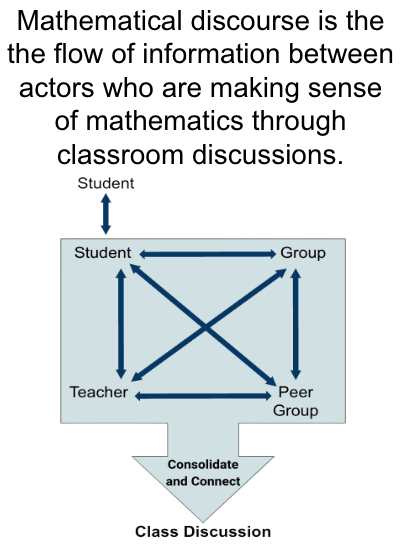
I know that a dissertation may seem like a small project to seasoned researchers, but for me it was a very impactful experience. I am very passionate about the topic of mathematical discourse and how it plays a part in shaping student math identities, and if facilitated well, allows every student to become part of the math conversation.
If you know me, you know that I think in pictures both when solving math problems and when synthesizing information or thinking about big ideas. So below I will include some visuals that will hopefully make a lengthy study feel digestible and meaningful.
Rationale
Discourse is the container for many of the NCTM 8 effective teaching practices and is why it was used to measure successful implementation of Problem Based Learning.
Many teachers struggle to move from direct or explicit instruction to a problem-based instructional approach. If we understand more about what teacher actions support the facilitation of math discourse, it could provide support for teachers who are hesitant to shift their practice. The findings could also support teachers in facilitating discourse in their classrooms.
Synthesis of Reviewed Literature
Inquiry and Problem-Based Instruction lead to increased student achievement. Gives ALL students the opportunity to participate in high quality, grade level math while building conceptual understanding and procedural fluency.
Universal Design for Learning is a set of concrete suggestions that can be applied to any discipline or domain to ensure that all learners can access and participate in meaningful, challenging learning opportunities, asset-based approach. UDL is designed to target the how, what, and why of learning.
Teacher implementation is at the forefront of this study. Teacher content knowledge, efficacy, and beliefs about teaching mathematics play a large role in teacher practice.
Coaching assignments vary by type, location, and focus.
Math discourse supports collectivist culture, helps build and maintain classroom community, is the measuring stick for successful PrBL implementation.
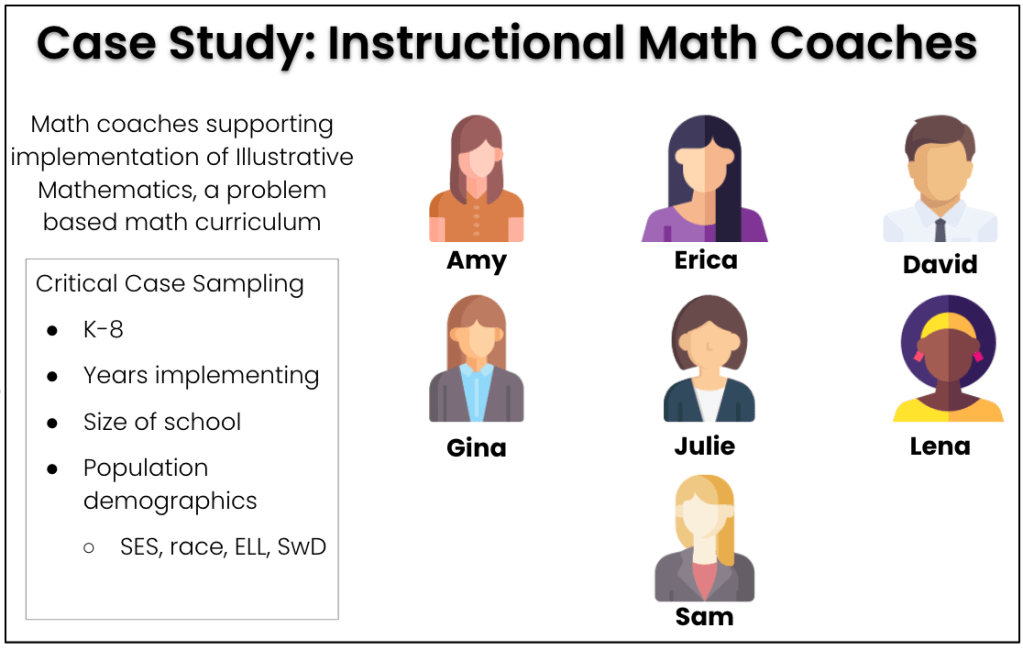
A case study was chosen for the research design because the study attempted to:
Search for meaning and understanding
Positioned the researcher as the primary instrument of data collection and analysis
Employed an inductive investigative strategy
Produces product that is richly descriptive
Themes and Findings
So Now What? How Do We Set Up a Discourse Rich Environment?
Below you will find strategies teachers used that contributed to setting up a discourse rich environment. I think this is a very clear illustration of when explicit instruction should be used in math class. Students need to be explicitly taught certain routines and procedures for engaging in productive discussions, providing feedback, and engaging with content. So to say there is no explicit teaching in a problem-based classroom is inaccurate. Great teachers know when to leverage explicit teaching and when guided inquiry is the best approach. Anyone reading this knows my thoughts on guided inquiry – that it should be the primary method of instruction and explicit instruction should be woven in as needed for examples like some of those provided below.
I believe that the findings from the study could support teachers in the following ways:
Interesting next steps for research studies could include:
If you’d like to read the entire dissertation, please email me and I’ll be happy to share:)
It’s been a while since I was able to sit down and blog. I have spent the last 3 years working on my dissertation for my doctoral degree…so excuse the pause in between this and the previous posts. I’ll be publishing a post soon to share the findings from that study.
This is the final part of the 3 part blog series I wrote regarding my son’s 8th grade (regular math) journey. He is now a junior in high school and I’ll share a bit more about his journey below. This post will summarize his growth and revisit the original reasons why I put him in 8th grade math. This is a very hot topic and I have received some very angry comments from readers about my decision. Every family has a decision to make regarding their child’s education. As parents, we don’t have all the answers…but we hopefully learn a lot along the way and always have our child’s health and love of learning as our north star. This was mine and my son’s decision. It might not be what you choose. My goal with both of my boy’s education is to ensure they maintain a love of learning. Every decision we make together is based on that north star. I wholeheartedly believe that if you love learning, there is no limit to what you can do!
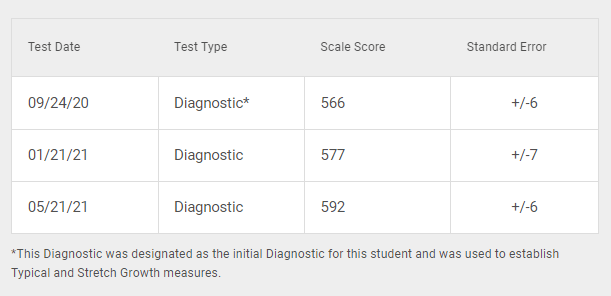
In order to see the relevance of these scores, it will be helpful to read the previous two posts in this series that set up the background information. It also may be helpful to notice the dates on the assessments. During his 8th grade year, his school was in session for 2 days a week due to the to the COVID-19 outbreak.
The figure below shows my son’s scale scores at beginning, middle and end of his 8th grade year using the iReady diagnostic. This is the benchmark assessment my son’s district used to show yearly growth.
The following figure shows growth goals based on the program’s algorithm and where he performed.
This figure shows his growth on each diagnostic by domain. Take a minute to look specifically at the Geometry domain. This clearly demonstrates that 8th grade math standards provide a foundation for success in geometry. He had almost 3 years worth of growth in that domain this year. If he had taken Algebra in 8th grade, he would have not received opportunities to engage in these foundational geometry concepts.
The purpose of this series of blog posts is to draw attention to the differences in course pathways at the middle school level and how they might affect student success in later math courses such as geometry. For some reason, there has been a race to Algebra, but I believe if we would slow down and allow students to experience deep understanding of grade level course standards, that they would be better prepared for future math courses and it might open up choices for their future.
Hopefully you can see that by engaging in grade-level math, my son was not held back from reaching his potential in mathematics (I’ve gotten some hate mail about that one). He recently finished Algebra II and still loves math. He plans to take College Algebra next semester and is thinking about careers in engineering, physics, or music production. He is 16 and really has no idea what he wants to do with his life (nor should he), but he thinks being a physics professor sounds fun. He is also interested in Civil Engineering, specifically city planning. And, his love of both music and math has us visiting a school to discuss music production this spring.
I think that as parents, we can agree that we want our kids to feel empowered to follow whichever career path they choose, and I firmly believe that early math experiences play a huge part in whether some careers feel within or out of reach.
Please know that there are absolutely well-designed accelerated math pathways that incorporate the major work of grades 6-8 in grades 6 and 7 so that students do not miss out on concept development necessary for future math courses. We have one at Illustrative Mathematics.
There are also cases in which students benefit from acceleration, but those cases should be thought through carefully. In many school systems, students are tracked into pathways based on a combination of grades, scores, and teacher recommendation which can lead to bias and inequity. My hope is that by reading these blog posts, parents will consider the right path for their child, and educators will look closely at their policies and systems in regards to math pathways. Can a student only take honors courses in high school if they go through an accelerated pathway in middle school? If so, that is an inequitable policy. Why not allow all students to opt into honors courses in high school? Why do we close the door on some and why is it our choice in the first place?
In my future blog posts, I will continue to advocate for empowering students to have more control over their academic decisions. After all, it’s their life.
A common question asked by school and district leadership is what do we need to do in order to get our students/teachers/school/district/community ready to engage with and find success in a problem-based curriculum like Illustrative Mathematics K-12?
Catalyzing Change “underscores the importance of children as active doers and sense makers of mathematics, who author and generate mathematical strategies and share their mathematical insights, not just become passive recipients of information (NCTM, 2020).”
Many districts seek to transition from teacher centered classrooms (passive) to student centered classrooms (children as sense makers), but the change seems insurmountable. There is often talk of “the shift” in pedagogy that has to occur in order for teachers to be successful. Common questions are how do we engage teachers in making that shift? What types of experiences do teachers and leaders need to take part in?
Before starting to think about student readiness, it is critical to assess the readiness of teachers and leaders in the system. What are the goals for math classrooms? What are your beliefs about how students should engage with mathematics? Are those views widely accepted in your context? Have you developed collective commitments about these shared goals and have key stakeholders been involved in that process?
When selecting a new mathematics curriculum, focusing on goals for instruction might be a great place to start. Questions to ponder might be, when I walk into a math classroom, what do I hope to experience? In this classroom, what is the role of the student? What is the role of the teacher?
In the publication Principles to Actions, The National Council for Teachers of Mathematics lays out eight instructional practices that “represent a core set of high-leverage practices and essential teaching skills necessary to promote deep learning of mathematics. (NCTM, 2014)”
Establish goals to focus learning
Implement tasks that promote reasoning and problem solving
Use and connect mathematical representations
Facilitate meaningful mathematical discourse
Pose purposeful questions
Build procedural fluency from conceptual understanding
Support productive struggle in learning mathematics
Elicit and use evidence of student thinking
If these practices are considered the foundation for equitable mathematics instruction, how will the curriculum being reviewed allow teachers to utilize them in interactions with students? Will they guide the curriculum search, professional learning, and implementation goals? These practices might be used as part of a rubric or lens for viewing curriculum materials; To what extent does <insert curriculum> support teachers in engaging in each of the practices outlined above?
Another key component of choosing a curriculum is how students will be able to engage with mathematics. A question here might be, how does this curriculum support students in engaging in the mathematical practices? How does the structure and content of the curriculum foster positive student identities in mathematics? How does the curriculum structure and embedded supports promote access and equity?
Selecting a curriculum is one step in a journey towards student centered math classrooms. NCTM’s Taking Action states that “even though well-intentioned, sometimes the demands of high-level tasks are reduced by teachers, almost subconsciously, in their attempt to help students move beyond confusion and struggles in order to reach correct solutions (NCTM, 2017).”
Teacher actions are at the heart of successful implementation. So the question is, once we have the goals and tasks in an aligned curriculum, how do we empower teachers to engage with the curriculum in such a way that students are positioned as mathematical sense makers?
NCTM’s Principles to Actions recommends that school leaders, “support sustained professional development that engages teachers in continual growth of their mathematical knowledge for teaching, pedagogical content knowledge, and knowledge of students as learners of mathematics (NCTM, 2014).”
NCTM’s Catalyzing Change adds that “teachers need time for professional collaboration and support to use curricular resources well and to ensure lessons and units are responsive to children’s strengths, needs, interests, and cultural and linguistic backgrounds (NCTM, 2020).”
When making a decision about curriculum selection and implementation, it is imperative that it is coupled with professional learning experiences that will allow teachers to continually engage in and plan for best practices for instruction. In preparing for implementation, other considerations might be, how can we set up our school calendar to provide time and space for teachers to learn from and with each other throughout the year? What structures (coaching and reflecting) do we have in place to support teachers with ongoing learning and reflection?
In making these decisions, it is imperative that national recommendations be at the center of decision making. Below is a list of NCTM publications that provide recommendations and support resources:
Principles to Actions
Each of the following books offer grade band specific versions:
In working with educators over the past 15 years, a common theme tends to arise when we approach learning and rigor. I have been asked (and I once asked as a teacher) countless times, what about kids who “can’t” do the work? What if they are “3-grade levels behind” or “score on a kindergarten or 1st Grade level” on standardized tests? I’ve had many tell me that “our kids can’t do that.”
TNTP published The Opportunity Myth , a research study which identified four key areas needed for students to flourish. These included:
Consistent opportunities to work on grade-appropriate assignments
Strong instruction that lets students do most of the thinking in the lesson
A sense of deep engagement in what they’re learning
Teachers who hold high expectations for students and truly believe they can meet grade-level standards
I’ve changed my reply to these “what if they can’t…” questions over the years and now ask, “but what if they can?”
The importance of high expectations cannot be underscored enough. Countless research studies have focused on just that. In the Opportunity Myth, TNTP calls it out as one of the four determining factors of student success, but many others such as NCTM, NCSM, Hattie, and Marzano all cite similar research findings.
First, we have to reassess the deficit-based model that has been so prevalent in the education system since the enactment of No Child Left Behind. When we look only at student deficits, we fail to see their brilliance. Once we make the shift to noticing what students can do, it becomes less about filling gaps and more about supporting them through the art of teaching.
I would challenge educators to question the purpose and usage of standardized tests in our systems. Standardized tests were never meant as instructional tools. They were designed to determine which students were meeting grade level standards, and which were not. They do not give a true picture of the whole child and when making instructional decisions, it is incredibly important that we look at multiple data sources; data sources that are frequent and actionable.
The Art of Teaching
As our district continues the journey of implementing Illustrative Mathematics (a problem based curriculum), I have noticed that the art of teaching has never been more important.
When students are given tasks with multiple entry points and multiple solutions, teachers can shift their attention to supporting students in the moment instead of “after the fact.” We can empower students to access grade level mathematics instead of only reacting to instruction by the creation of multiple intervention groups. Are there times when small group intervention is the necessary? Absolutely. However, there are many more effective ways for teachers to scaffold and support students with learning gaps while engaging in grade-level work. Here are a few ways teachers can use their art and expertise to support students in grade level work:
Crafting questions to use the following day to reveal new strategies
Selecting students to share their work that might support the next step for other students
Providing a math tool or graphic organizer to support students as they work
Forming a small group to revisit a task and discuss strategies or introduce a strategy
Allowing students to revisit and revise their work
Crafting Questions
When I know what students know, what strategies they are comfortable with, and what connections they are or are not making, I can carefully craft questions to advance their thinking. For example, a student is drawing a picture every time they are asked to add (combine) groups. I could ask, I wonder what that would look like if you used numbers instead of pictures? Why don’t you try that and I’ll come back to see what you come up with.
Another great way to progress student thinking is to select students to share a strategy that another student might not have thought of. For instance, in the scenario above, I might ask a student (B) to share that used a diagram or expression to find the sum and ask how his representation and that of the student (A) who drew a picture were the same and different. Or I might ask student A to check in with the student B and talk about their strategies. These interactions can take place whole class using the 5 Practices, or in partnerships or gallery walks.
Math Tools and Organizers
With the adoption of Illustrative Mathematics, we set students up to engage in tasks that allowed The Standards for Mathematical Practice to be part of each learning experience. There are many ways that utilizing the practices allow students to engage in grade-level work, but let’s zoom into MP5: Using appropriate tools strategically.
There has been much discussion in the math world for many many years about the inclusion or exclusion of math tools when students engage in mathematics learning. The emphasis on knowing math facts from memory has caused instruction to halt in order to “make students ready” to engage in grade level content. In fact, the memorization of basic facts continues to be a stumbling block in many classrooms, including special education classrooms. In fact, this quote from Strengths-based Teaching and Learning in Mathematics lays it out clearly: “If some experts have described algebra as a gatekeeper for the high school student, fluency with basic facts is the gatekeeper for the elementary school student who struggles – particularly a student with disabilities.”
There is a myth that without basic facts retrieval, students cannot engage in higher level problem solving. I wonder what would happen if we allowed students access to tools that take that limiter out of the mix? For instance, a student who is working with fraction equivalency needs a calculator to multiply the numerator and denominator by the same factor (2/2, 3/3, 4/4) to look for patterns and generate equivalent fractions. I’ve witnessed on many occasions that students gain fluency with facts, BY engaging in grade-level activities such as this.
The world is changing, you would be hard pressed to find a job available today that does not use software programs, assistive devices, resources, or tools to support the mathematics we do on the job. In fact, our state has already included the Desmos calculator on all sections of our test for grades 6-8 and end of course exams. So has ACT, SAT, and AP exams.
There will be times when we notice that several students are stuck and need an extra nudge or an opportunity to explore concepts further and may want to pull them together for a small group discussion. For instance, I notice four students are confusing addition and subtraction. I’m not sure if it is vocabulary, conceptual, or operational so I pull them back and we work with groups of counters. I cover two sets and tell them how many are in each set and ask how many there are altogether. I use this as a formative assessment to determine my next steps with them in the group.
Revision
Revision is so important in teaching for mastery. For too many years, math classrooms have given the big end of unit test, teachers grade it, and it goes home. Students need to have opportunities to see their mistakes, revisit them, and revise them. If the goal is mastery, we must live our words. I have seen this play out in many ways in classrooms.
During a number talk, a student hears another students strategy and says “I’d like to revise my answer.”
Or during a group discussion when a student group shares their work and another student notices a mistake in their own and asks if he/she can go back to their desk and revise their problem.
A teacher hands out a unit test and meets with students individually to go over their work. She tells the students that she is available to conference with them if they would like to revise their tests and resubmit.
Great teachers use these opportunities to show students that they are teaching for mastery by allowing for review and revision.
The art and expertise of teachers has never been more critical. Students come to use with varied lived experiences, strengths and goals. It is our privilege and opportunity to help them flourish in our math classrooms through access to high quality, grade level tasks and high expectations.
I’ve been spending some time redoing my floors and as I was planning for the threshold, I thought this would make a great task! This is a great task for CCSS 5.NF.A.1.
Act 1:
What do you notice? What do you wonder?
Act 2:
After watching Act 1, you might introduce students to laminate flooring and joining one surface to another. Have them take a look at this guide to plan the threshold being used and explore the space needed.
One you have done that, you can share the following information:
I’ve been filming in Tabitha Eutsler’s classroom all week to capture a progression of student learning. Every day I have been in her classroom this week there has been moment after moment of excitement as we see the understanding of students unfold through purposeful questioning and student feedback.
Tabitha is a master facilitator. She spends lots of time at the beginning of the year (and throughout) building her classroom community because she knows that is what supports students in being able to communicate with each other, disagree, argue, challenge each other and celebrate each other so that every student has not only the opportunity to learn, but the opportunity to belong. Her students are mathematicians and they know it.
These were the learning goals for each lesson this week:
Monday:
Generate equivalent fractions.
Understand two fractions as equivalent if they are the same size.
Tuesday:
Identify and generate equivalent fractions.
Understand two fractions as equivalent if they are at the same point on a number line.
Wednesday:
Represent and compare fractions in a way that makes sense to them.
Thursday:
Compare two fractions with the same denominator with the symbols < or >.
Friday:
Compare two fractions with the same numerator with the symbols < or >.
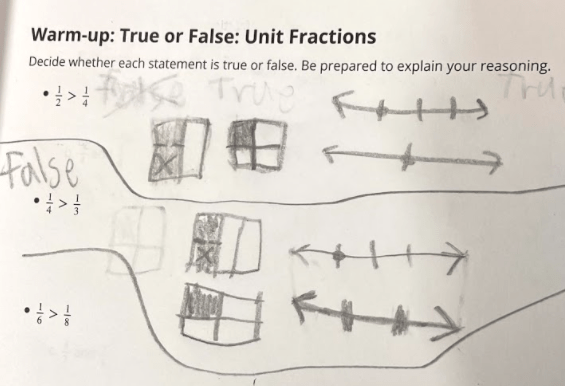
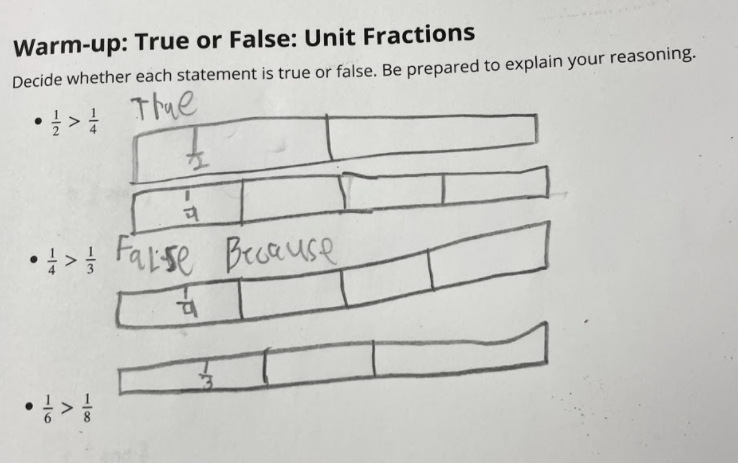
Today is Friday and students started the lesson with an instructional routine called True or False?
The first problem posed was:
True or false?
Students were asked to think independently for a minute silently and then Tabitha asked them to share and turn and talk to a partner to see if they agreed or disagree with each other. She then asked for students to pop their thumbs if they had an answer they were willing to share. Below are the conversations that followed for each of these tasks:
Student 1: I think it’s false
Teacher: Why?
S1: Because 2 and 4 are two different numbers and 4 is greater than 2.
T: So you looked at the numbers on the bottom and thought 4 is bigger than 2 so this must be false? Did I get that right?
S1: Uh-huh
T: Okay, thank you for sharing. Continue. S2 what do you think?
S2: Actually I agree and disagree. I agree it’s false but actually I would look at the top because it is actually equal, not 4 is greater than 2.
T: So why do you think it is false then?
S2: Because it says that ½ > than ¼ and actually that is actually equal.
T: So you think it should say ½ = ¼ and they are the same? Ok. Does anyone have feedback?
S3: I disagree with you because the top are equal, but the bottom numbers are not.
T: So do you think it is true or false?
S3: False
T: Okay go ahead and give us your reasoning.
S3: 1 and 1 is equal but the 2 and the 4 aren’t.
S2: I kind of see what you are saying. The top is equal but the bottom is not.
T: So are you saying that ½ is the same as ¼ now or you think they aren’t actually the same.
S2: No I don’t think they are the same. I want to change my answer because of what he said.
T: I think I’m gonna throw out a different challenge. How about we get our books out so you have a place to write and I printed some more fractions strips and number lines for you guys. So how about now you show me what is going on in your brain. Can you write it down and show me? So it is asking ½ > ¼ and we are saying that is false. So I want you to prove it to me.
Go ahead and talk to your partner. Is it still false? Or is it true?
If you want to bring your books up or use the markers you can. I’m gonna review where we are at. We have 3 of you saying that is false. You are going to come up and still defend false or if you changed your answers.
S1: I think it’s true because I can see that ½ is bigger than thirds because would you want one of a third or would you want a full half? The half would be bigger so you would have more. That’s why I think this is true.
T: Feedback?
S2: I disagree, I think it is false because I drew a number line and on this you said thirds instead of fourths. Oh yeah fourths. Right here, that would be where ½ happened. Right here would be ¼. It’s diagonal.
S1: I agree with how you saying that but you can also split ½ into 1/4s so it would be a smaller piece. It would be ½ broken up into fourths so you would get a littler piece. I’ll show you. We have this whole big piece right here, now you want to get this piece.
T: Can you show him what you mean by pieces using HIS number line? Can you show him where the pieces are on his number line to compare the sizes?
S1: Yeah. So this is ½ and this is ¼ so this piece is bigger.
S2: Oh, I get it so what you’re saying is this is here. I agree with S1 now.
T: Everybody we haven’t seen fraction strips yet. S3 is going to show us fraction strips. So be looking at your paper. Does everyone have true written down?
S3: I drew two number lines. This one is split in halves and this one is spit in fourths. The half is double the size of the fourth so that’s why I think it is true.
T: Feedback for S3?
S4: I agree because this goes further than this one.
T: Oh so the half is further than the fourth?
S4: Uh-huh
T: After listening to our family give me a thumbs up or thumbs down is it true or is it false? Okay. Thank you. This is true. So you might be thinking I kind of see it but we’re in luck because we have a couple more problems to practice this.
True or False?
T: Are you defending true or false?
S1: I am defending false. As you can see here when you make fourths you get smaller pieces. When you make thirds you get big pieces. I labeled them small and big.
T: Feedback – what do you think about that with the pieces she was talking about?
S2: I agree because I did the same thing but I didn’t notice that. I didn’t do the number line but I did the picture and it blowed my mind.
T: Thank you so you had a connection that your picture was similar but doing it this way grew your brain even more? Thank you. Who would like to defend next?
S3: False because if Ms. Eutsler gave me a candy bar would I want the bigger piece or smaller piece? Since it is a candy bar I would want the bigger piece. So it’s false because that piece is not bigger than that piece.
T: You shared something with me about the bottom numbers. Can you share that with the class?
S3: So on the bottom you always want the lesser number because the less number has the bigger pieces than the bigger number.
T: So if we look back, a yes or no please. Based on everything that you heard, is this true? It is false.
True or False?
S1: I think it’s true because um if you draw it on a number line you see that 6 is farther away than 8 so the less away that it is is the one that is true.
T: Feedback?
S2: I agree that it is true but you forgot one. These are five pieces and you need to draw one more.
T: Look at your paper, do you have true based on what our family just told us? It is true.
Following the warm up, the students worked on a word problem in which two students disagreed about 5/6 or 5/8 being greater. Several students shared and a student ended with this comment:
S: This kind of goes back to our true or false questions that we did earlier where if the numerator stays the same then the denominator determines which is one is greater.
T: And how would you determine with the denominator which one is bigger?
S: When the denominator is smaller.
T: Because the size of the pieces is what?
S: Bigger.
This is the power of a problem based classroom. The students uncover misconceptions as they begin the task, but as the teacher supports their productive struggle by allowing them time to grapple with new ideas, share their thinking with others, and see solutions from other classmates they begin to make sense of the mathematics and develop reasoning and proof. This is possible because of the teacher’s understanding and application of the mathematical teaching practices. Ms. Eutsler poses purposeful questions, supports productive struggle and facilitates discourse so students are positioned as the experts in the room. When they need support, she provides it in the means of tools, questions, and the purposeful sharing of student work that provide visual representations from which others can compare, contrast and connect to their own. It is the skillful art of teaching.
Problem based classrooms provide students time and space to develop deep understanding of math concepts. They struggle, they perservere. They make mistakes and they correct them. They agree and they disagree. These are the habits of mathematicians. The world doesn’t behave like a math textbook. Students need to know how to make sense of contexts and scenarios by playing with mathematics in a classroom with a teacher who values mistakes and problem solving, holds the belief that every student can do math to high levels, understands that math is about depth not speed, and knows that students will meet the expectations that are set for them.
I wanted to post an update to my first post about acceleration in middle school. My son is in 7th grade math this year and I thought it was important to share his progress.
I am using his test results below to demonstrate two points regarding some misinformation and in an attempt to debunk the myths that tend to get hurled by those who believe in back to basics (procedural, wrote, calculation) math.
Myth #1: Inquiry based math will not meet the needs of students who are on or above grade level.
Myth #2: Students who score on or above grade level should have access to an accelerated pathway to get the challenge they need to make growth in mathematics.
Before looking at his assessment results, here are a few facts about this year:
Our middle school students lost a quarter of learning last year, spent more than a quarter of this school year only attending classes 2 days a week, and the other part of this year attending 4 days and 1 virtual day (his virtual day he attends a choice program).
My son’s teacher is using Illustrative Mathematics (via the Desmos curriculum platform).
His teacher uses the 8 Math Practices and the 5 Practices for Orchestrating Discourse to purposefully look at, discuss, and connect student strategies.
This is his assessment from the beginning of the year. According to this report, to meet typical growth of a student at his level, he should grow by 11 points on this assessment by the end of they year.
These are his middle of the year assessment results (after 1 quarter of 2 days of instruction and 1 quarter of 4):
What do you notice? What do you wonder?
Hopefully you noticed a few of things:
The curriculum is not holding him back.
The course pathway is not holding him back.
His teacher is not holding him back.
In fact, the opposite is true. He is being challenged and he STILL LOVES MATH!
He met the criteria to be placed in 8th Grade Algebra next year (at the beginning of this year – see a problem here?). An email went out and I promptly responded asking that he be placed in 8th grade math next year. Why? Because I believe that 8th grade math is the foundation on which Algebra 1 and Geometry are built and I want him to enter high school equipped to succeed in both of these gateway courses. AND because I trust educational research done by experts in their fields. And the research is clear; There is no place for accelerated math pathways in middle school.
Some common arguments (and my responses) for keeping accelerated pathways are:
My child scored advanced on the state assessment/my child is gifted/my child is special.
Great! Let’s keep that going by providing them a strong foundation for future math success.
If they love math and want extra opportunities, have them join a math club or explore http://www.brilliant.org (awesomely fun math)!
I want my student to graduate with Honors.
Maybe the current honors system is set up to disadvantage the many and needs to undergo change.
If the system cannot or will not be changed, I suggest opt in honors – let kids decide if they want to take honors courses and agree to additional or modified requirements. (This keeps the classrooms diverse and allows students a stake in their educational decisions while still offering the opportunity for honors credit).
My child has to take Algebra I in middle school in order to take Calculus in college.
Do they? Do they really? Have you talked to the colleges that your child (is planning to attend 5-6 years from now) and do they require Calculus? What must your child demonstrate in order to be placed beyond Calculus in college (MANY students end up having to retake Calculus in college even though they took it in high school). This is sometimes determined by ACT/SAT score or entrance exam.
And also, is Calculus the course your child should take in high school or are they entering a career that would be better supported by Statistics?
And also also, there are ways to take Calculus without being accelerated in middle school. That road is still open to my son (if he chooses that is the course that will set him up for success in college).
If you find yourself wondering if your child should take Calculus in high school, I encourage you to read these articles.
The most common argument for taking Calculus in high school is that students need it to get into great colleges. I decided to see if that was true, since I had just attended a lecture from Stanford professor, Jo Boaler, who mentioned Stanford does not require it and that colleges would rather have students take Statistics their senior year. Here is a table I created after looking at the websites of each of these universities and their math requirements:
If you want to learn more about the research from the National Council of Teachers of Mathematics and the National Council of Supervisors of Mathematics, check out these articles and books:
This post has been one of many sitting in my drafts, but I decided to post it even though it is a few years old because it offers an opportunity for self reflection.
My son was doing math homework a few weeks ago, he came across a problem that went something like this:
Mr. Jones had 3.75 ounces of Kool-Aid and he put them into cups of 0.25 ounces. How many cups of Kool-Aid was he able to pour?
I was checking email while he was completing his homework, but looked up when I heard him mumble under his breath. “Ugh, it’s 15, but I have to show my work.” I asked him why he was frustrated and he said because he knew the answer but he had to show all of the steps. Knowing his teacher puts a strong emphasis on Number Talks, I told him I’m sure that’s not the case, I’ll just write a little note that says that you solved it mentally.
The next day he came home and brought me his homework. He said well I got 21/22 because I didn’t show my work on the problem. I was perplexed so I emailed his teacher to discuss. I thought this must be a misunderstanding.
The reason I share this story is because I think sometimes as educators, we lose sight of what our goals are for students in mathematics and we can send a message that we ourselves do not believe in.
Let me first say that I greatly respect my son’s teacher and that I know that she wants what is best for him. She uses a number talks routine in her classroom and has students work on mental math to build their number sense strategies on a regular basis. However, I think my son is confused as to when he is “allowed” to use mental math and when he has to calculate on paper.
As I reflect on this experience, I think back to when I was a teacher and I made graphic organizers for my students to “draw a picture” to solve. Although I think this is a good way to get students to visualize problems they haven’t encountered, I now feel that I overused this method and I can recall some students who were frustrated by this practice.
It is important that we not lose focus of our purpose and that we constantly reflect on our practice to ensure our philosophy matches up with our actions in the classroom. It is easy to get bogged down by state testing, mandates, homework practices, etc. but we owe it to our students to check ourselves and question our practices when it leads to frustration.
While we were making S’mores I thought about how many marshmallows we might be able to fit in our mouth so I called in my oldest after my youngest almost choked on 5. Here is the result:) I’m sure he would want you to know that “he could’ve fit in more” but I stopped him for you know…math purposes!
I think this is an excellent fit for CCSS and MLS K.NBT.A.1.
Act 1
How many marshmallows can he fit in his mouth? (Don’t try this at home)
What number would be too low? Too high? Just right?
My son and I have started roasting marshmallows over our fire table and decided this could be a fun winter task!
This task could be used for many different scenarios, but I am choosing to use it for 2nd grade CCSS 2.OA.A.1 (and a little 2.OA.C.4) and MLS 2.NBT.C.11 (2.RA.B.3). Could also work for 1.OA.A.1 and 1.RA.A.1.








 mscastillosmath