It’s been a while since I was able to sit down and blog. I have spent the last 3 years working on my dissertation for my doctoral degree…so excuse the pause in between this and the previous posts. I’ll be publishing a post soon to share the findings from that study.
This is the final part of the 3 part blog series I wrote regarding my son’s 8th grade (regular math) journey. He is now a junior in high school and I’ll share a bit more about his journey below. This post will summarize his growth and revisit the original reasons why I put him in 8th grade math. This is a very hot topic and I have received some very angry comments from readers about my decision. Every family has a decision to make regarding their child’s education. As parents, we don’t have all the answers…but we hopefully learn a lot along the way and always have our child’s health and love of learning as our north star. This was mine and my son’s decision. It might not be what you choose. My goal with both of my boy’s education is to ensure they maintain a love of learning. Every decision we make together is based on that north star. I wholeheartedly believe that if you love learning, there is no limit to what you can do!
In order to see the relevance of these scores, it will be helpful to read the previous two posts in this series that set up the background information. It also may be helpful to notice the dates on the assessments. During his 8th grade year, his school was in session for 2 days a week due to the to the COVID-19 outbreak.
Why I won’t Put My Son in Accelerated Math in MS (Part 1)
Why I won’t Put My Son in Accelerated Math in MS (Part 2)
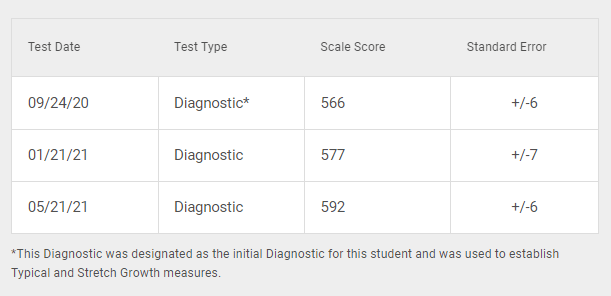
The figure below shows my son’s scale scores at beginning, middle and end of his 8th grade year using the iReady diagnostic. This is the benchmark assessment my son’s district used to show yearly growth.
The following figure shows growth goals based on the program’s algorithm and where he performed.

This figure shows his growth on each diagnostic by domain. Take a minute to look specifically at the Geometry domain. This clearly demonstrates that 8th grade math standards provide a foundation for success in geometry. He had almost 3 years worth of growth in that domain this year. If he had taken Algebra in 8th grade, he would have not received opportunities to engage in these foundational geometry concepts.

The purpose of this series of blog posts is to draw attention to the differences in course pathways at the middle school level and how they might affect student success in later math courses such as geometry. For some reason, there has been a race to Algebra, but I believe if we would slow down and allow students to experience deep understanding of grade level course standards, that they would be better prepared for future math courses and it might open up choices for their future.
Hopefully you can see that by engaging in grade-level math, my son was not held back from reaching his potential in mathematics (I’ve gotten some hate mail about that one). He recently finished Algebra II and still loves math. He plans to take College Algebra next semester and is thinking about careers in engineering, physics, or music production. He is 16 and really has no idea what he wants to do with his life (nor should he), but he thinks being a physics professor sounds fun. He is also interested in Civil Engineering, specifically city planning. And, his love of both music and math has us visiting a school to discuss music production this spring.
I think that as parents, we can agree that we want our kids to feel empowered to follow whichever career path they choose, and I firmly believe that early math experiences play a huge part in whether some careers feel within or out of reach.
Please know that there are absolutely well-designed accelerated math pathways that incorporate the major work of grades 6-8 in grades 6 and 7 so that students do not miss out on concept development necessary for future math courses. We have one at Illustrative Mathematics.
There are also cases in which students benefit from acceleration, but those cases should be thought through carefully. In many school systems, students are tracked into pathways based on a combination of grades, scores, and teacher recommendation which can lead to bias and inequity. My hope is that by reading these blog posts, parents will consider the right path for their child, and educators will look closely at their policies and systems in regards to math pathways. Can a student only take honors courses in high school if they go through an accelerated pathway in middle school? If so, that is an inequitable policy. Why not allow all students to opt into honors courses in high school? Why do we close the door on some and why is it our choice in the first place?
In my future blog posts, I will continue to advocate for empowering students to have more control over their academic decisions. After all, it’s their life.


This series continues to amaze. Honest and personal as a parent, insightful and wise as an expert and a teacher. Thanks!
LikeLike
Thanks John!
LikeLike