The Amazing World of Gumball Math

One of the fourth grade teachers I work with had a fantastic idea for reviewing measurement. She said she was frustrated tripping over gumballs from the tree outside the school and it could be really fun to review measurement (the concept her students had been working on) using this problem-basegumball 2d situation as a springboard.  She asked if I could help her come up with some activities for her lesson the following day and she would work on some too.

I put together some activities for her using the Gumball Character for the TV show The Amazing World of Gumball as the theme while I was participating in a Twitter chat (her version turned out way better!).  While I was working on my version, I decided this would also be a great way to review multiplication using arrays and would create a great entry point for all students.

She set up the activity by telling students they would all start using the multiplication sheet by making arrays and then writing down arrays others had made.  They didn’t have to draw the array (there was space if they wanted to), but they did have to write the corresponding multiplication equation.  After a few safety tips and discussion about determining which tools they would need for the measurement portion, we headed outside.

Arrays

We had several surprises as students completed the array activity.  Some students were just counting gumballs and then trying to figure out the multiplication equation that would go with it, which was fine until they got to a prime number.  We prompted with,

“Make an array using those gumballs.”

Some needed a review as to what an array looked like, once that was cleared up they were on their way.


Other students were making arrays, but not sure how to set up the equation when they encountered factors they did not have memorized (red flag!) such as 14 x 2 or 7 x 6.  We asked things like,gumball png

“How could we partition the array into friendlier facts?”

For some students that was enough, for others we had to partition it and then follow up with

“Do you see 10 groups of 2? How many groups of 2 are left?”  


Extensions

This got me to thinking about extensions to the activity such as:

Get a few handfuls of gumballs.  Write the factors and the product

or  Write the corresponding division sentence. How can we represent the situation if it is a prime number?

This would be a great introduction or review of prime numbers and lead to a discussion of order of operations such as 19 = 2 x 9 +1 or division with remainders, which really opens up this activity to fifth grade students as well.

In third grade, this could be used as students explore arrays and strategies for multiplication and division.  Students could write the fact families for each array or the strategies they used to solve the multiplication sentences.  Also great as they are learning about the commutative property.

Measurement

As students began their measurement activities, we noticed even more misconceptions. One of the problems that got misinterpreted was “The number of gumballs that fell in one square meter.”  Some students started measuring the perimeter of one square meter and others tried to find a square (sidewalk) that measured one square meter.  Many groups required prompting for this such as,

“Let’s reread the question.  It says…”  “Where did the gumballs fall?”  

Students: “over there!”

“So where should we be measuring?

Once they realized that they would be finding the gumballs that fell, many students still did not know where to start.  We asked,

“What would one square meter look like?”  “How could we measure that?  

We only had one meter stick so students were having a hard time figuring out how to make the square.  We asked,

“How many centimeters in a meter?” “Do we have a tool that would measure that?”  “How could that help you?

This was really the prompt that led to what you see in the pictures.  Students started to realize that they could lay measuring tapes on each side.  However, when I went to look at their squares, many had not measured to the 100 cm mark on each side, they had used the entire tape.  I then prompted with,

“How many centimeters should be on each side?”  “Is that what you have here?”

Once that was established, some students thought they would then fill the square meter with gumballs and count it.  After all that’s what we do when we practice area in third grade.  We count the square units inside.  This led us to ask,

“Let’s go back to the question.  What does it ask?”gumball 2

Some still needed more prompting such as,

“So how could we find the number of gumballs in the square meter you just made?”

Students, “Count them?”

“Would that answer the question?”

Students, “Yes.”

“Then it sounds like you have a plan.”

We (but most importantly, the students) really enjoyed this opportunity to get outside and get our hands dirty.  The great thing is that while completing these activities, students managed to clean up over 10 paper bags of gumballs from the ground outside our school!

Student engagement was off the charts and the activity allowed for multiple entry points.

One of the students who has an intellectual disability also decided to use a pan balance using rocks and gumballs to explore.  It created the opportunity to discuss comparison of numbers and weights.

Here is a link to some of the activities.  The document Mrs. Anderson made is more inclusive and I will add that once she sends me the link.

There is also a link to a American Forests site that I think could be a cool extension on measurement of the height of trees.

If you don’t have gumball trees at your school, try using rocks or sticks or other seedpods!

You Know Nothing Jon Snow

rcet

I’m going to assume that if you are reading my post (on a math blog) chances are that you too are a Game of Thrones fan and will get the title:)  If not, google it!

A colleague and friend of mine, Chelsey Meyer, and I presented on Boosting Engagement in Math Class today (and will again tomorrow) at the RCET Conference at MSU.  In doing so, we got to attend several great sessions offered by other Missouri Educators.  If you haven’t attended the RCET Conference, I highly recommend it.

The first session we went to was on becoming a Google Certified Educator.  When we got to the conference today I thought I was proficient in using Google apps, when I left that session I felt like I wasn’t even using Gmail to its potential.  This presentation could have easily been a week long conference on it’s own.  Some of the things we learned about were: Choose Your Own Adventure, Google Sites, Google Scholar, and tons of add-ons and additional features in apps we were already using.

If you don’t know much about Google Certification,  you should definitely check it out.  I didn’t even know that the certification existed…and best of all, the tests can be taken from your home, on your computer, for $10!  Google also offers all of the training for said tests, free.   Check it out here.

We also got to attend a session on Google Classroom that really answered a lot of my questions about how to best integrate apps into the classroom for online collaboration.  We were able to brainstorm together about how we might use this in conjunction with our LMS and save students time on the tech side to allow more time for the learning and collaboration.

Another great piece of information we gained today was Google CS First.  This is a site with ready-made activities to start your own club in things like Game Design and Animation!

I’d love to hear from you if you are a Google Certified Educator and will try to keep up on posting about my journey (and Chelsey’s) as we complete the training and take the tests!

Gimme a Break 3 Act Tasks

I was recently asked to do some more 3 Act Lessons in our 4th grade rooms with fractions! I can’t even say fractions without smiling!  I can’t even say 3 Act tasks without smiling!  I have to say what I love most about 3 Act math tasks is that our most struggling students not only have an entry point to grade-level material, but they are successful with it.  There is nothing like the look on a student’s face who has just proved to him or herself that he/she can be successful in math class AND have fun doing it!

I looked through my usual go-to sites for 3 Act tasks and had already used many of them with students so I did another google search and found a wonderful blog by Kyle Pearce that had many different fraction tasks using Kit Kat bars.

Our students were (like most 4th graders) struggling with the concept of adding fractions with like denominators.  They needed a visual representation and they needed time to puzzle with it.  I used Kyle’s Task 2 for our first experience.  I really liked this task because it could be viewed as fractions with like denominators or structuring to one whole and adding on.  So many times, students go right to a procedure instead of taking time to think about the most efficient way to solve a problem and this problem sets that up very nicely.  Many students were able to visualize that the two halves could combine to make a whole first and then just add the one fourth.  We had tech problems on this one and ended up writing out most of the answers on paper, so unfortunately I don’t have student work pics.

The next lesson was Kyle’s Task 3 in which students had to subtract fractions with like denominators.  I really liked this task because it allowed students to visualize mixed numbers and improper fractions by providing a picture of “one whole” in the context of subtracting fourths.

Each student worked with a partner to view and discuss the tasks.  This question is one that we asked after watching the first act:

task 1 question

After Act 2, we asked:

multiple choice.png

question 2


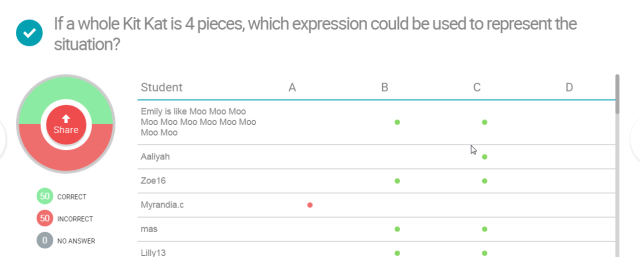
We had two correct answers as options and noted that to students.  One was in the format of mixed numbers and the other was the improper fractions.

At this point, we had several students who were still struggling with how to represent this situation mathematically. Before moving on to the next question, we let them view the correct answers and wrote them out so they could choose which to solve.

We then had them:drawing

Here are a few responses:

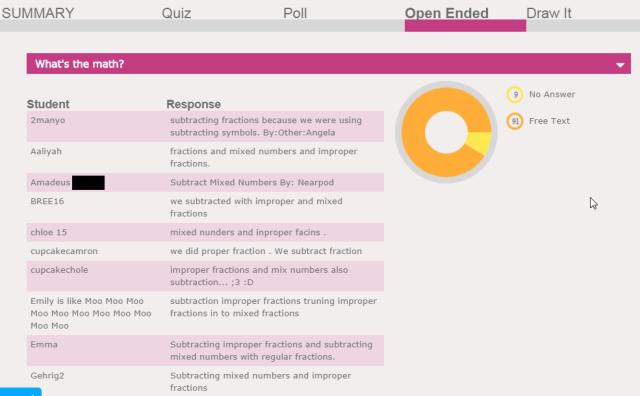
After the reveal, we had volunteers come defend their answers and discuss which strategies they used.  Finally, we had students tell us the math:

whats the math

It’s really easy to gauge which students are on track after the lesson and which are still struggling by their answers and their explanations.

After talking with students during and after the activity, it was apparent that this visual model was a great support for naming fractions both as mixed numbers and improper fractions.

We will definitely use this one again!


Objective: Tell Me At the End

In our district, teachers are required to post their objectives somewhere in the classroom for each lesson including the “what” and the “why.”  I’m a huge fan of inquiry based lessons and I think this can really ruin a great lesson.

Since 3 act tasks are all about exploration and questioning, I never tell my students what the objective is when we are working on a 3 act task.  My first slide always starts out: Objective: Tell Me At the End.

When I started doing more 3 act tasks in classrooms, I noticed some visible tension when I showed this slide and announced to students that “Today I’m not going to tell you what we’re learning about in math.  You are going to tell me.  We’re going to do some wondering and some thinking and some talking and some questioning and then you’re going to tell me what math you did today.  I know I (or your teacher) usually start out by saying today in math we are going to learn about blah blah blah.  But not today.”

I can truthfully say that this is one of the best things I ever did in math class.  Students really seem to enjoy the wrap up when they get to tell me what math they did.  The best thing is that they usually come up with about 4 more objectives than what I would have written on the board.  It’s also a natural closure for the lesson and students get to have the final word.

Now that several classrooms have had me teach a few 3 act lessons, I can hear students start talking early in the lesson about what math operations they will be using which really opens up some great dialogue and reinforces vocabulary.  I have to wonder which objective they will remember at the end of the day.  The one the teacher wrote on the board, or the one they typed out?

3 Act Lessons with Nearpod

Both of my schools are part of the Ignite initiative in our district which means that my 3-5 graders are 1:1 using Chromebooks and K-2 are about 1:3 with iPad minis.  It is really exciting to finally get to make use of the opportunities offered on the web for boosting student engagement, modelling with mathematics, and student collaboration and reflection.  But what I was most excited about, was finding a program or app that would allow me to make 3 Act tasks more interactive for everyone.  I wanted each student to get the opportunity to share their thinking after they discussed their thoughts and strategies with their groups.

I started by trying our Canvas management system and put the tasks on an assignment page.  The problem with that was that students could look ahead at the reveal if they scrolled down and the reports that I got weren’t great.  I then tried making a Canvas module that would allow me to put each act on a different page and have multiple assignments.  Still clunky.  Still less than meaningful reports.

I tried presenting the tasks on my device and using TodaysMeet for students to share their solutions.  That didn’t keep the information very neat and it was difficult to see everyone’s thinking (I do love this website for number talks though:).

After trying each of these and being disappointed, I was on the hunt for something better.  One night, at a district “Appy Hour” I was excited to see a session that might be just what I needed…and it was!  I started using Nearpod right away.

Pros: Presentation is completely controlled by me when students are on their individual devices.  They cannot progress to the next screen until I move mine.  This to me is very important in a delivery method.

Students can write, draw, or take a picture of their work and upload it.  Then I can share it to each device while they explain their strategy.

Works on Chromebooks and is great for K-2 on iPad with ability to draw with their fingers or take a picture of their manipulatives.

Multiple question types.

Cons:

Limited size of video uploads.

Many features are not available in the trial version and the gold version is quite expensive.

Check out my 3 Act posts to see some examples of the reports and images I can collect from students as they solve these tasks.


Contemplating Math Instruction…

I have really been struggling lately with balancing “test prep” and quality math instruction.  Teachers begin to stress the test as early as the first day of school, but for many it is a balancing act of preparing students for the ever-looming MAP test and providing them with high quality math instruction.  At the beginning of the year we review our pacing guides, start a calendar to make sure we hit all the major points before March, and begin the mad dash to teach!  Although we have instruction days well into the middle of May, we rush to cram in as much as possible to be ready for MAP.  In my opinion, our new math curriculum adoption is a good one.  We use My Math and it does a very good job of providing conceptual experiences for students to build on as they move to more abstract concepts.  However, we have to cut out or glaze over many of the lessons in 3-5 in order to “fit it all in” before MAP.  Teachers struggle with this conundrum and are rightfully irritated that they must spend less time exploring and more time cramming.

We have been trying out inquiry based lessons and 3 Act Math tasks whenever we can find the time…which got me thinking…should we have to find the time?  Isn’t this the type of math we should be doing all of the time?

So I began digging into some word problems and watching students as they solved them.  What I realized (much like what Dan Meyer explains in his Ted Talk) is that although we have contextualized these problems to involve real world objects and scenarios, they are in fact, NOT real world math.  They are plug and play procedural drills.

Tonight my son was running a fever and I couldn’t find that little Tylenol measuring cup they give you with the medicine, so I looked on the back of the container and saw that I could dispense it to him in teaspoons or ml.  For his age and weight, he needed 1 1/2 tsp of medicine or 750 ml.  I found a plunger that had a marking for 500 ml, but the rest of the marking had worn off, so I had to determine how much more than 500 ml I would need.  Of course this is an over-simplified problem for a math teacher, but I have found that many students when faced with problems like this, have no way to start a solution.

So what are some of the hindrances teachers face when providing quality math instruction?  What are the answers?  If you could write the assessments, what would they look like?  Am I the only one who gets shivers down my spine when someone mentions “test prep?”

Assessments are fantastic planning tools.   They are necessary and integral to quality instruction.  I am responsible for providing professional development for teachers in mathematics and part of that job is helping them plan how they will prepare students for the MAP test.  I struggle with this on a daily basis.  My philosophy of teaching screams one thing and my state screams another!  I feel like I am selling out, but I also feel that I would be letting down my district if I didn’t push the prep.  I just wonder if we should stop more frequently to ask “what’s our purpose” when it comes to assessments.  Sigh.

1st Grade – 3 Act Math – Shark Bait

I have been borrowing a lot of 3 act tasks from Graham Fletchy‘s blog.  Today we did a measurement lesson he calls “Shark Bait.”  This was our first 3 Act lesson in 1st Grade at York and we used Nearpod to make this an interactive lesson using ipads.  Students worked in partners to discuss, generate questions, estimate and prove their solutions.  The thing we love about Nearpod is that it allows the class to stay together as we work through the activities and allows for interactivity by having students respond and even draw pictures of their solutions.

We presented this to students by telling them that this would be a new type of math lesson, that we would not be giving them their objective upfront, but that they would have to determine the math they used at the end of the activity.

Act 1: Video

What do you Wonder?  Examples of student responses:

“How big is it?”  “How tall is the worm?” “What is the length of the worm?” “How many inches is it?”

Oh so you are wondering about the size of the worm.  What do you think he used to measure the worm?

“Cubes”  “Squares” “Blocks”

Oh yeah, I saw that too, it looked like he was using blocks to measure it.  So we want to know about how many blocks it would take to make it to the end of the worm?

“Yes.”

We then talked a little bit about estimation and an estimate that was too high and one that was too low.  Then students were asked what estimate did they think was just right?

2016-01-07 Branizor Shark Bait

2016-01-07 Tummons Shark Bait.png

Act 2: So then we asked how we could find out?  We allowed students to talk to each other and then told them they could use any of their math tools in their room that they thought would help.

Many students rushed up to the math materials and one group stayed behind.  I asked the little boy in the group if he had an answer.  He said, “yes, it’s 22.”  I said, wow can you explain how you got that answer?  He said, “yes, 5 + 5 is 10 and then 5 more is 15 then 20 and 2 more is 22.”  I then asked him and his partner if they could then work out if the worm grew 20 more cubes, how long it would be.  While they worked on that, I went to check on some other groups.

One little girl had a bunch of nickels out.  I asked her what she was doing and she had them arranged in an array with 4 in each row.  I said, hmmm let’s look at the information we have, how many of each cube does it say their are.  She said “five.” So could we arrange them in groups of 5? “yes.”  She said “it’s 22!”

Another partner group was getting out connecting cubes.  They had two towers of 10 and a tower of 2.  When I asked them about their tower they said it’s easier to add 10 so they just made two tens and a two and it was 22.  When we later shared out, I called them to the board and pointed to the information.  I said, you said you used two tens.  Where did those two tens come from?  They pointed to the top two fives and said that is ten and that is ten (pointing to the bottom two).  “and then we added two more.”

After everyone had a chance to draw their answers on the ipad (we had to talk about what it looks like to prove your answer with a drawing or number sentence), I called up a few students to share their strategies.

Act 3: I then asked, “do you want to find out if your solutions are correct?”

“YES!”

We played the act 3 video as they watched hopefully to find that they were all correct!  Lots of little thoughts of satisfaction floated around the room:)

The last thing I asked was, so I told you we were going to come back to our objective.  So what math did we do today?

“Adding.” “Counting.” “Measurement.” “Doubles.” “Skip counting.”

We had such a great time with these kiddos today!  I am always blown away by the level of deep thinking and conversation I hear with kids at each grade level.  Today was no different!

Why Do I Care?

Tonight I was working with an eighth grade student I have been tutoring for a while.  He recently had a quiz in math class that he got a D on due to a couple of plug and play mistakes.  I asked, “did you ask your teacher if you could fix your mistakes and get back some credit?”  He said, actually she gave me a bunch of worksheets to complete.  He then proceeded to pull out a packet of 6 pages front and back on the chapter that he could complete for extra credit.  Hmm.  I will not comment yet.

He said, we can just  breeze through them because this is stuff we already did.  I caught his meaning.  It didn’t matter if he knew how to do the math, it would never be on the test again.  Double hmm.

So we sat down to look at the mountain of snow that had accumulated before us.  We worked out a few problems on the first page and then I said, “well let’s go over the word problems because those are the ones you can’t check on your own.”  My dear student has found that he can very quickly “complete” his math homework using a math app called Photo Math.  And let me tell you, I don’t blame him.  If I was forced to complete 18 problems that were exactly alike, I would look for a more efficient way to get on with my night also.

We looked at the first word problem and I found myself having a Deja voo moment.  I’ve seen problems like these before.  As I worked to wrap my brain around the question, I realized the problem I was having was that I just didn’t care what the answer was.  And if I didn’t care, he certainly didn’t care.

Here is the first problem we looked at:

“Health Club  Currently 96 members participate in the morning workout, and this number has been increasing by 2 people per week.  Currently, 80 members participate in the afternoon workout, and this number has been decreasing by 3 people per week.  In how many weeks will the number of people working out in the morning be double the number of people working out in the afternoon?”

I’m not embarrassed to say, I had no idea how to approach this.  I scribbled down a bunch of equations, but I was limited by the fact that I knew (the game of school dictates) this word problem somehow needed to match the problems above it that we had been working out.  I couldn’t recall the format of how to set up the equation using all the information I was given and have it “match” the previous problems.  I also hadn’t solved a problem like this since math class which was many many years ago(no I’m not willing to divulge just how many).   Does that say something about the value of such a problem?

I am genuinely (what’s the word I am looking for) confused? angry? Baffled? that our students time is not more valuable to us.

But that really goes back to the question, what math do students need to know to be contributing members of a society?  That’s a topic for another time:)

To address the Photo Math app, there has been a lot of hype about “non-google-able” problems.  I agree, I want my students involved in experiences that require them to think and apply their learning.  But most of all, I want their learning to be relevant(to them now or in the near future).  This is definitely a filter we need to put our tasks through.

The problem referenced above would probably make it through the non-google-able filter, but it would never make it past the latter.

So let’s try a word problem that I might come across involving a health club:

I want to start working out, but I need to find a health club that meets several criteria:

Has childcare, Offers fitness classes, Is open late, is around $50/month or less.

I narrow it down to two.  The names are Chesterfield Family Center and the Pat Jones YMCAPat Jones YMCA.  Click on the links to go to their websites.  Compare the two clubs and provide a recommendation for which I should join.

Some things to keep in mind: Base the cost on a family size of 3: 1 adult and 2 children.  Cost difference between paying all at once and paying monthly: Do I qualify for a Corporate membership discount?  What does it cost if I want to bring a friend with me?

How many people might encounter a problem similar to this in their future?  I’m willing to bet the answer is significantly higher than if I had asked the same question about the original problem on the worksheet.

If I wanted a word problem that assessed the content in the original, I would probably go with something like this: 3 Act Ditch Diggers.  Should this be considered a word problem?  Should we re-brand that phrase?


3 Act Math

One of my favorite math teachers/bloggers/speakers is Dan Meyer.  He really “gets it” when it comes to making math meaningful for students and I learn so much from him every time I watch a video, hear him speak, or read a blog post.

He has inspired many people to take mathematical thinking to the next level and turn students into question askers instead of question answer-ers (is that a word?).

Many elementary math teachers have began making videos to explore concepts using his 3 Act model and this post will explore one of those.

If you type 3 Act Math into Google, you get lots of different sites where educators have begun posting libraries of lessons.

I have always admired this approach to mathematics and it aligns so closely with my instructional philosophy that I decided to try it out with some students.  I went into 3-5 classrooms and introduced the lessons as “you figure out the objective” instead of telling students what we would learn in class today.  They had to figure out which questions to ask, which operations to use, and why the answer didn’t match the problem they set up.

The first lesson I tried, was from Graham Fletchy’s blog  here.  I presented the lesson in a module format with each act on a seperate page in our Canvas learning management system.  They first watched the video for Act 1 and then were ask what they wondered about the video.  Students said things like “How many skittles are in each bag? How many did it take to fill up the jar? How many bags did it take?”

So naturally the next step was to see if we could answer their questions. Dan Meyer uses an ingenious strategy to get students to engage with the math.  He first asks them to write an estimate that is way too high, and then one that is way too low.  Every student has an entry point with this approach.

We talked about what it means to estimate and what was a crazy number that they know could not be right.  Then we talked about a number that might be close.  We then talked about what we might need to know to figure out how many were in the jar.

Enter Act 2:  We opened the page that had a picture of how many skittles were in each bag, and how many bags there were altogether.  What operation could we use knowing that information to arrive at a solution?

Students did the math.  We revealed Act 3 and some students were down right mad.  How could their answers not be correct?  What factors played into that.  They did the computation correctly.  Finally we were able to talk about the fact that maybe not every bag had the same number of skittles in it or some were left over at the end. We talked about how math in our daily lives is sometimes messy, there are multiple factors that we have to take into account in addition to computation.

To wrap it up, I asked students what they thought the objective was today?  Where was the math?

Answers came as multiplying, adding, estimating.  And although we did all those things…the true purpose was productive struggle.  Engagement. Critical thinking.  Collaboration. Put your finger on a practice standard. Nailed it.

Can’t wait to blog about some of the other 3 Act lessons we used and 3 Acts with K-2!

Special thanks go to Graham Fletchy and Dan Meyer for sharing their knowledge and resources!

More Coding in Math Class

What I (and other educators) have noticed over the years is that student attention spans are dwindling, they require more stimulus, they give up easier when faced with a challenge and in doing so don’t every find a true sense of accomplishment.  They are afraid to make mistakes, and in turn, they are afraid to try.

I am constantly looking for ways to engage students in problem solving situations that require persistence; Opportunities for them to be meta cognitive, to reason through obstacles, and to persist in finding a solution.  I found that in code.

Anyone who knows me knows that I am a tech enthusiast, so when I first heard about Hour of Code, I had to try it for myself!  I was so impressed by the skills required to complete coding lessons, I felt like it needed to be an integral part of our daily routines.  So I asked our 3-5 teachers if I could introduce it to students and I don’t think any of us were prepared for the levels of engagement we saw.  Students were talking to each other, they were problem solving, they were helping each other…and best of all, they were proud of what they accomplished.

The experience opened up dialogue about fixed mindsets vs. growth mindsets and we got an authentic opportunity to talk about productive struggle and the willingness to fail.

After the success we saw, we decided to incorporate coding as an option in our Math Workshop block as a “may do” when daily work and individualized learning programs were complete.  Weeks later, they are still excited to complete coding challenges.

I truly believe that the opportunities that students have had at “debugging” their coding lessons will transfer into their mathematical reasoning and better prepare them for scenarios they will face in their daily lives and in their future careers.