3 Act: Stack Em Up

One of my fifth grade teachers emailed me yesterday and asked me to teach a lesson on volume next week.  I started thinking about what the students might be struggling with and decided this was a perfect example of a 3 Act math task that would clear up some misconceptions.

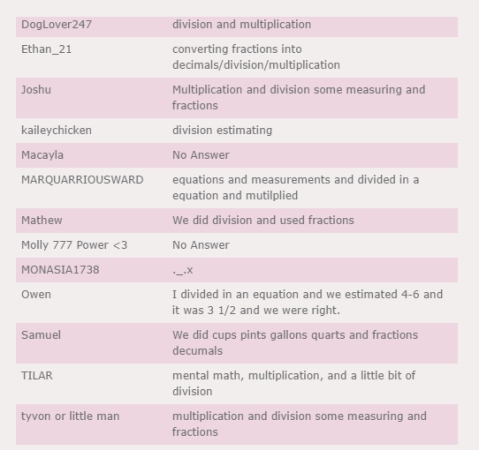
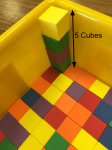
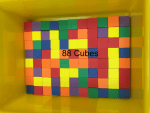
I grabbed my tub of 1″ foam cubes (we use them for quiet differentiated dice) and started stacking them inside a tub.  I couldn’t find a tub or box that had easy dimensions, so I thought it would be a great way to get students to work out volume, but also to ask questions about efficiency and accuracy that might help them name the need for the formula and connect it to task.

So here are the tasks and the link to the tasks in Nearpod:

Act 1:

What did you notice?  What are you wondering?

How many cubes will it take to fill the tub.  Give an estimate that is too low and one that is too high.

Act 2:

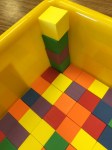
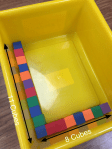
What information do you need to find a solution?

Cubes = 1 cubic inch

Without labels:

With labels:


How many cubes will it take to fill the tub?

Act 3:

Were you right?

Who is willing to defend a solution?

Who is willing to disprove an incorrect solution? (We chose this question because after watching How Mistakes Make You Smarter, we’ve been focusing on being intentional about calling attention to incorrect answers and allowing students to analyze their own and their peers mistakes.  We talked to students about this and how they are helping others become problem solvers by sharing their wrong answers)

What’s the math?

Extension:

Is this an accurate representation of volume?  Why or why not?

What could we use as a more efficient method to solve for volume that would also be more accurate?

What is the volume of the tub? (8 1/2″ x 11″)


Repurposed Bottle Cap Fractions

When we were testing in our tech room the other day, I noticed a bucket of bottle caps.  I asked the instructional technologist about them and she said that she enters the codes from them and then has just been saving them because she felt bad throwing them away. I asked if I could have them and she said sure!

IMG_4659

I did a google search on ways to use them for math games and found a sort with decimals, percents, and fractions.  I was talking to one of our 4th grade teachers about modifying it for her class and we decided on equivalent fractions.  When I started making them, I looked up the standards to make sure I set it up with the correct fraction ranges and I found that many of the other NF standards could be made into games for practice using bottle caps too!  I got distracted and pumped out 4 different tasks in about 30 minutes.  I wrote the standard on the front of the Solo cups she gave me to store them and I took pictures of the games for task cards by putting 4 images on a piece of cardstock and cutting them apart.  They fit really well in the cups.  I am going to ask teachers to start saving the mini Pringles containers for the future!

This slideshow requires JavaScript.

The funny part is, I hadn’t even made the original game we discussed yet!

Later in the day, our Kindergarten teachers used them for making ordering number games and missing number games.  Our 2nd grade teachers used them for repeated addition through skip counting.

I know this idea has been around for a long time…but we were excited to re-purpose these caps into useful tools for individual practice!

I’ll try to post more pics as we create them.  Please share your ideas!

Are You Educated? Or Are You a Learner?

I’ve been really reflecting on the state of our educational system lately.  In part because of the big changes that have been happening in my district.  Changes that involve the fostering of 21st Century Skills, Problem-Based Learning, and the integration of technology.  It has led me down some really philosophical paths in my spare time and caused me to evaluate my personal teaching philosophy more than once.

Sometimes I think the phrase “educated” gets used interchangeably with the the word learner, when in fact, the words mean very different things.

To be educated implies that someone has undergone a formal education program.  They have sat through the classes, done the work (or not), and passed the final exam (or not). They have been taught at and they have taken in information.

Being educated seems to imply that there is nothing left to learn.  That since the person has participated in a formal educational program, they are done.  They get a stamped diploma and they can go out into the world and be successful. (Is it bad that I get a mental image of prep school jackets and golf polos?)

I would argue that being a learner is a much more fluid thing, a constantly evolving journey that continues indefinitely.

Being a learner is being engaged in the process of education; either formal or otherwise. People are learners because they have a need to know.  They need to know because they are interested in the topic, or they need to know to get a job done or a problem solved.  That does not mean that what they are learning has to be a favorite subject.  It just means they have a reason for learning it.

These situations call for ingenuity in finding information.  It may take the form of an instruction manual, a YouTube video, a phone call or video conference with a colleague or friend or family member.  Sometimes it might start with a Google search and end by falling down the rabbit hole into the world of blogs and help centers.  It might be researching scholarly articles or scientific journals, calling a tech call center or doing an image search.  Learners know how to find information not because they are smarter, but because they never give up.  They NEED to know.

I’ve heard the term “ungoogle-able questions” pop up a lot lately in education and I understand from where this stems.  However, I don’t agree that we should always be looking for “ungoogle-able” questions.  Most problems we face in daily life are google-able…and that is a great thing!  I also don’t think we should discourage students from using google (or calculators…but that is a story for another time) as a resource when solving problems.

What we need to be doing is finding a way to connect with students so that they have a need to know about whatever they are studying so that they are actively engaged in their education.  So that hopefully, we have transformed them into learners; not educated people.

We also must ditch the idea that all students are university bound.  Our world is changing yet we are still teaching students as if university is the finish line.  Many very successful people I know never attended college.  Some are entrepreneurs, some self-taught, some are builders or makers or tech gurus.  Universities cannot keep up with the rate at which new career fields are being invented.  We must teach students to be thinkers and doers, but most importantly; learners.

Flipping Review and Anchor Videos

One of our 5th grade teachers was talking to me the other day about how she had about a week to review before our state standardized test.  We have been talking about and trying to iron out the details to start flipping our math classrooms in 4-5 since we got our devices in September.  To me, this sounded like the perfect opportunity!

A Kindergarten teacher I work with recently told me she has been using a website called Blendspace with her students to better organize her PBL units.  I really liked the visual layout of the program and have been milling around in my head what application it might have for math.

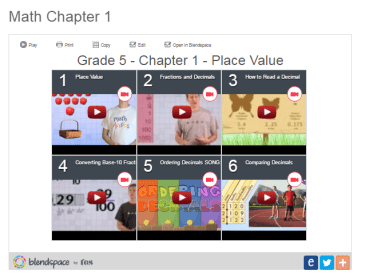
I decided this was definitely one!  I played with a couple of possibilities and ended up deciding on creating a Blendspace lesson per chapter in the Math textbook we use to organize anchor video lessons for students to use for review of concepts they aren’t firm on, but we could also very easily use next year when we start fully implementing flipped classrooms.  Ch 1

The coolest feature I found was the collaboration button under the share option.  I can enter in the email addresses of all of the teachers that teach that grade-level and they will have instant access to the videos to embed in their own Canvas pages, but will also be able to add videos of their own.

I mentioned to this to my Math Coach colleagues today at coaches meeting and we decided this would be a great way to collaborate on lessons we or our teachers create so we aren’t re-creating the wheel each time we want to flip a lesson.

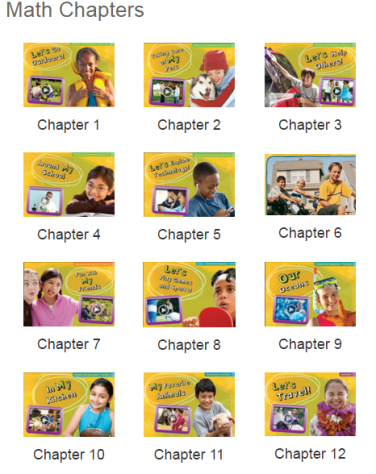
Canvas ChaptersEach of my teachers share their Canvas page with me, so I created a page that would be very easy to navigate for students and embedded the Blendspace lessons in each page that is linked to the main anchor video page.

I inserted the Anchor Video link on her Math
Workshop page and it was ready to go!

I can now share these pages to the Canvas Commons and import them into other 5th grade classes very easily.  Since the Blendspace lessons are embedded, they will automatically update each time we add a lesson.

Now on to 4th grade!

Misconceptions in Measurement

I tried out the Gatorade is Thirst Aid task with five classrooms this past week. Three 4th grades (2 were combined) and two 5th grades.

I knew there would be misconceptions about measurement, but the information we gained was invaluable in really pinpointing where students were struggling with conversion.  It was pretty interesting to see that it differed at each grade-level.  Probably because they both just finished units on Measurement and were learning slightly different standards.

Interestingly enough, our 4th grade students had a better grip on how many ounces per cup and the fact that we needed to multiply or divide to find the answer.  They also had a better grip on how to use the remainder.  Many started by writing in cups and ounces and then when asked if there was another way to write it, came up with the mixed number of cups.

repeated addex2ex18 8 8 4

Our 5th grade students had the misconception that there were 16 ounces in a cup.  They were no doubt thinking ounces in a pound, but it was interesting that many of the students had this same thought.  What I have noticed with this group of students is that they often try to over-complicate the process when solving 3 act tasks.  They think there is a trick in there somewhere which leads me to believe that they don’t have a firm conceptual basis of how to work with numbers and operations.

I noticed two misconceptions that really stood out to me.  One student wrote his answer as 3.4 cups because there were 3 cups with 4 ounces remaining.  He did not see the remainder as a part of the composite unit 8, but instead wrote it as four tenths in decimal form.  Does this student have a firm understanding of decimal place value?

The other misconception that I thought was really interesting was that the solution could be written as 3/5 cups in fraction from because the decimal notation was 3.5.  This one really got me thinking about how to integrate fractions and decimals more thoroughly as related concepts.

And the part that I love: “What’s the Math?”

ex5Winchell WTM Gatorade

Gumball Activity

Today, with those two 5th grade classes, we did the gumball activity I mentioned in a previous post and it was really surprising to see that many of the students did not have firm grip on 36″ in a yard” or “100 cm in a meter.”  They struggled less with visualizing a square meter than the last class, but instead had a difficult time determining how many inches were in a yard, and how to tell how long a meter was.  I did a lot of questioning with these groups like, “how many inches are in a foot?   How many feet in a yard?” and “what do you know about metric measurements?  Why are they easier to work with?  How could you use that to help you?”  A few students were able to tell me that they are in tens, but many then decided that 10 cm was a meter.  I showed them the size of 10 cm and asked, “does that make sense?”  They agreed it didn’t and then were able to tell me it would be 100.  They were pleasantly surprised when they saw that the measurement tape they were using was exactly 100 cm long!

One of the most surprising things I noticed was that many students could not agree on an approach to the question, “how many gumballs across is the sidewalk?”  I saw measuring tapes laid across the sidewalk, I saw gumball lining the edges and I had students asking me how to solve this one.  I assumed (yes I know) that measuring with non-standard units would be the easy one for them, but they were trying to find some way to measure the gumballs and count and couldn’t come up with a solution.  When I asked them to reread the question, I asked, “where would you start?”  They were able to say, “counting the gumballs.” I then asked, “do you need a measurement tool for that?” That’s when it hit home.

We asked students several clarifying questions after we completed the activity.  When we asked students how many centimeters in a meter, they were able to tell us.  When I asked “how do you know?” A student said, “because I saw it on the stick when I was measuring.”

This just firmed up the hypothesis we had that measurement is best taught in context.  The teachers and I discussed how we might change our measurement lessons next year to allow them to have more experiences measuring and converting with objects.

I asked a student, “why do you think we did this activity today?”  I was saddened when the reply was, “because it might be on the MAP test.”

I knew it was time to interject and bring in some examples of when and where they might see this in their daily lives.  I said, “yep, it might be on the MAP test, but let me tell you why I care about what we did today.  I am getting ready to re-seed my lawn and seed bags come by how many square yards the bag of seed will cover.  If I didn’t know how big a square yard was or wasn’t able to calculate about how many square yards in my lawn, I might buy too much seed or not enough.  Those bags are heavy and I only want to buy what I need.  Here is another example: I recently repainted my son’s room.  Paint comes in gallons that tell me how many square feet the paint will cover.  Does anyone know how I would figure that out?”

Student: “that’s area.”

Me: “You’re right, and how would I find the area of the wall?”

Another Student: “length times width.”

Me: “Yep, so how would I find the area of the wall?”

Another student: “The same way.  Measure the length and width of the wall.”

Me: “And then what?”

Student: “multiply it.”

And yes, I did tell them that I don’t want them to know this because it’s gonna be on the MAP test, I want them to know because it will be important to them when they own their own home.

What I gained from this activity is the fact that when planning projects such as this, it is so very important to include many types of question sets that span the grade-levels especially those leading up to the current.  Many times, we as teachers assume that students have a firm grip on a concept because it was taught many grades before, but we really have no way to gauge their experiences before they enter our classroom.

Assume nothing.


How Tweet It Is…

One of the best things I have done this year for professional development is to participate in Twitter chats that interest me.

When I have talked to teachers about this, they seem overwhelmed by getting started, so I have added some instructions below on how to find chats that interest you, creating a Twitter account, tools that make it easier to chat, and chat etiquette.

Where to start:

  1. Search this link  to add all of the educational Twitter chats to your Google Calendar.  See below for a diagram of what to click:

Chat Schedule.png

2. If you don’t already have a Twitter account, go here and sign up.  I put this step second, because I think it’s nice to have a reason to sign up first:)

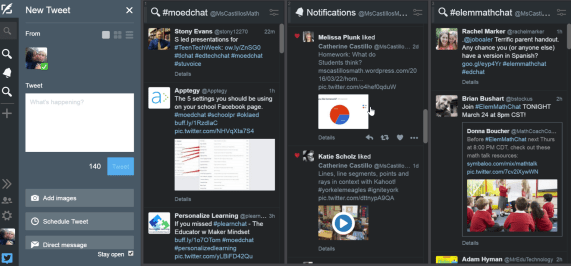
3. Bookmark the Tweetdeck website and sign in with your new Twitter Account.  Here is what the dashboard looks like:
2016-03-24 13_28_26-TweetDeck.png

column add.png

a. Click on the “+” button to add a column.

b. Choose the column type that you would like to add.  I like to add a notifications column and a search column for each chat I am trying to manage around the same time.  My standard setup is show above.

column selection.png

Click on two little lines at the top right of your column.  Click on “Content” and the dropdown box shown above will open.  Type in the hashtag for your chat in the “matching” text box.  There are lots of other options you can mess around with, but I find this simple setup is good enough for me.

4. Open Tweetdeck at the time your chat is scheduled to start and look for the first question.

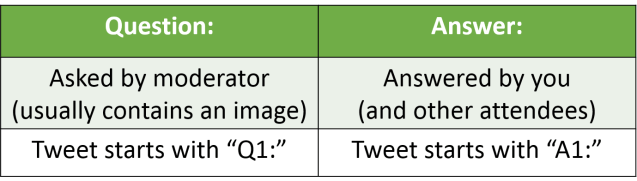
tweet table

5. The moderator will pose a questions labeled Q1: and you will respond to that question with “A1:.”  Follow this protocol for all answers respectively.  Make sure to add the hashtag for your chat onto your tweet.

Feel free to comment on other peoples comments and retweet great ideas!  A great way to grow you PLN (Personal Learning Network) is to follow people that you learn from!   This way you will see all of their tweets in your feed.

Please post questions and comments and I will try to address them in the comments.


3 Act: Gatorade is Thirst-Aid (4.MD.A.1)

My very first 3 Act Tasks inspired by a trip to Walgreens for a sick teenager!  Here is the link to the lesson on Nearpod.

Act 1:

How many cups are in the bottle of Gatorade?  Write an estimate that is too high and one that is too low.

Act 2:

What information do you need to help you find a solution?

collage-2016-03-22 (3)

1 cup = 8 ounces

The Gatorade bottle has 28 fl oz.

Act 3: 

Please give me feedback as these are the first two I have tried on my own.

Thank you to Melissa Plunk for suggesting the video edits!

3 Act: I Feel Sick (5.NBT.B.7)

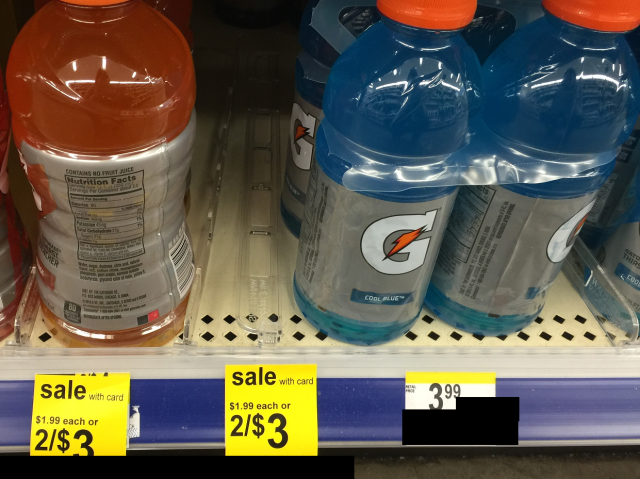
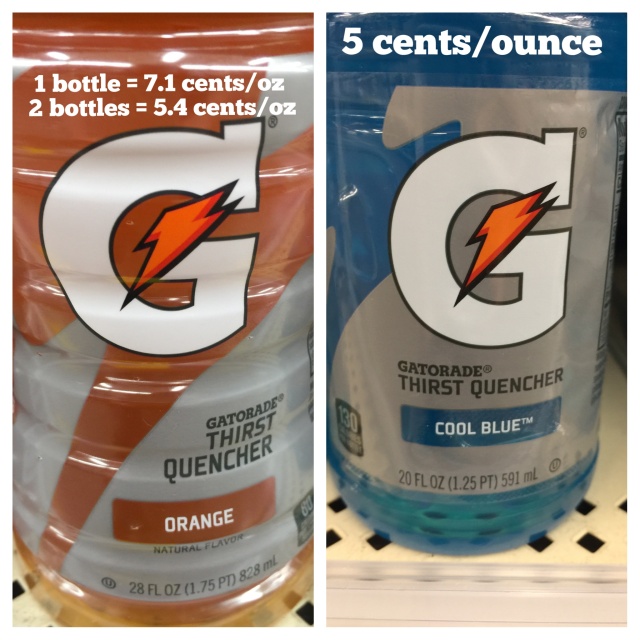
I was at Walgreens last night to buy my sick teenager some Gatorade when I was faced with the following scenario, so I decided to put it into a task for review of division of decimals.  I also thought it might be a good primer for the measurement chapter they are on. Standard 5.NBT.B.7.  Here is the Nearpod Link.

Act 1:

Act 1 Gatorade.png

Estimate how much each bottle cost per ounce.  Give a too high estimate for each and a too low estimate for each.

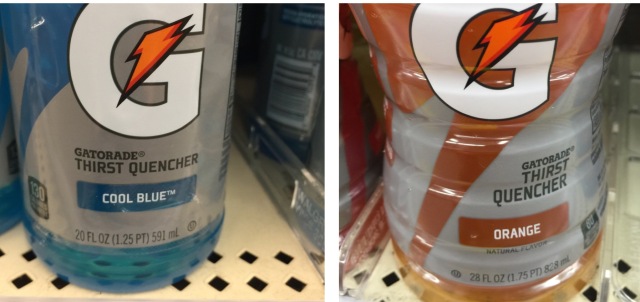
What information do you know?  What information do you need?

Act 2

FullSizeRender.jpg

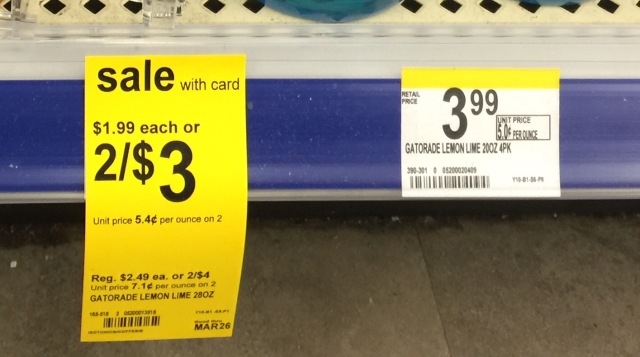
How much does Cool Blue cost per ounce?  How much does the Orange cost per ounce if you buy two?  If you buy only one?

Act 3

IMG_4311 (1)IMG_4311

Processed with MOLDIV

Processed with MOLDIV

What’s the math?

Please leave me feedback on how I could make this task better.  It’s my first one!

Would it be better to start with a video of me opening a wallet with $5 in it and reveal with a video of me checking out and the change I get back from the cashier?  Come to think of it, that would be a great 3 act on percentages (for tax).

Homework: What do Students think?

We (4th and 5th grade) have been itching to flip our classrooms ever since we got our Chromebooks this year.  We have experimented with flexible scheduling and had students watch the lessons in class, but due to the fact that many of our students don’t have internet access at home, we have yet to be able to fully implement it.

Chelsey Meyer and I decided we were just going to dive in and open up our library to students in the morning to come watch their lessons before school if they didn’t get a chance the night before and make it happen!  We worked on an Imagine Grant to allow us to buy some comfortable seating for the Library (Learning Commons) and started talking about how we would implement it (fingers crossed).

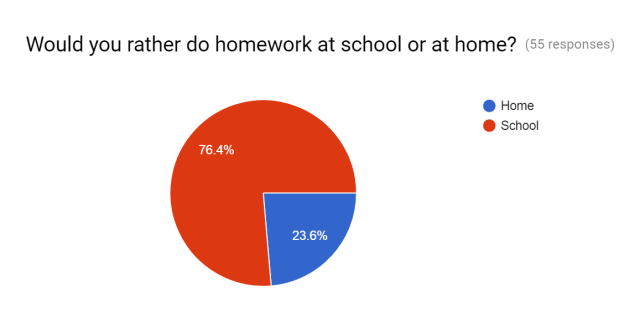
We talked to the students in her class about it and it became very apparent that our ideas of how they learn best might not match up to their own.  So we gave the students (in 4th and 5th grade) a homework survey in order to gauge their preferred method of homework and the time of day that would work best.  The results are below.homework 1

After looking at the results, we had a lot of questions. Who are the students that like homework?  What specifically do they like?  Homework 2

Did they really like worksheets?  Or was it that they had’t had the experiences with other homework projects?

homework 3

Almost 33% of students said they like their current homework, but only 24% liked doing it at home.  Due to our before and after school duties, it made sense for us to start by opening up the Library early in the morning to start and then re-evaluate after a period of time and look at putting some supports in place to allow us to open in the afternoons.Homework 4We decided to open up the school in the morning to them, do a week of project based homework and a week of flipped lessons and give the survey again.  We also decided to start with 4th grade math and bring in 5th grade when we could gauge the number of students we would have in attendance.  We are sending home a letter to parents explaining the change and will start next week!


What’s the Whole?

Our fourth grade students were having trouble visualizing subtraction of mixed numbers, so I was asked by the fourth grade teachers to do a lesson reviewing this concept.

I decided that we would start with a problem from their math books, but instead of solving it, just talk about and visualize what one whole would look like in the problem.  We started with a problem (3 2/4 – 1 1/4) that did not require regrouping and I asked students,

“What would one whole look like in this problem?”

I asked students to turn and talk to a partner to come to a consensus.  Many of the IMG_3888students immediately started solving the problem and raising their hands to tell me the solution.  I reiterated the fact that I was not looking for a solution, I simply wanted them to think about how we would represent 1 or one whole in fraction form.
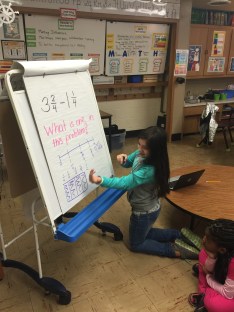
Student: “four fourths.”

“How do you know?”  “Can you prove it?”

Student: “Well on a number line that is split up into fourths, it would be four fourths.”

“Can you draw that for us?”IMG_3890.JPG

Student: “If you split up one whole into four parts, it would be all of the parts.”

“Can you draw that for us?”

“Oh okay, that makes sense.  So will one whole always be represented by four fourths?”

Students: “No.”

“Let’s try another problem to see if we’re right.”

4  3/5 – 2 4/5

“What is one whole in this problem?”

Students: “five fifths.”

“How do you know? How can knowing that help us solve this problem?”

“Do you remember in 1st grade when you learned to make exchanges with base-10 blocks?  What could you exchange one long for?  How many base-10 cubes?”

Student: “10.”

“In this problem what could we exchange one whole for?  Let’s look at it using our virtual manipulatives.”

At this point, we had students go to the fraction tiles manipulatives on ABCya and begin modeling the problem.  abcya

“So how many whole pieces should I have?”

Student: “Three.”

“And what other tiles do I need?”

Student: “three fifths.”

“Come show me what that looks like.”

Once the students had the pieces on their computers, I asked:

“So what could I exchange one of these wholes for?”

Student: “five fifths.”

“Let’s do that.  Let’s lay them right underneath the whole to make sure that works.  Yes, it works.”

“So now can we solve this problem?”

Students: “Yes.”

“How?”

Student: “We can just take away two wholes and four of the fifth tiles.”

“How many does that leave us with?”

Student: “One and four fifths.”

We did this with several examples before having students work independently.  After they modeled it, we asked for volunteers to come show the class what they did.  Here are some examples:

One of the things that we discovered during this lesson was that several students were having difficulty organizing their fraction pieces.  We ended up having them draw a line down the middle of their screen and when they removed pieces, they moved them to the other side.  That way they could easily tell which tiles were left over.  This virtual manipulative tool is a little sensitive, but it is one of our favorites for ease of use.

subtracting mixed numbers

This is a flow chart to help students visualize that there are different types of problems and they should be treated differently.

After the lesson, we had students complete the independent practice sheet on the last page of this packet.  The other pages can be used in small groups with students to show another way to visualize the difference.